The Atlantic Telegraph Company and the 1857 attempt
In 1856 the American businessman Cyrus Field joined British partners to form the Atlantic Telegraph Company. John Watkins Brett, who had promoted the first cable across the English Channel, became its president. Charles Tilston Bright was chief engineer, Wildman Whitehouse, a surgeon with an interest in electricity, was electrician, and the Glasgow physicist William Thomson sat on the board. The route ran from Valentia Island on the southwest coast of Ireland to Newfoundland, the shortest crossing between the two continents.
No single ship could carry the cable, so it was divided between two warships lent by the British and American governments, HMS Agamemnon and USS Niagara. The first attempt left Valentia on 5 August 1857 with Niagara paying out. Early on 11 August, after about 380 nautical miles had been laid, the cable parted in the paying-out machinery. It was lost in deep water.
The 1858 cable and its three weeks of service
For 1858 the engineers changed method. The two ships met in mid-ocean, spliced their halves together, and steamed in opposite directions. Several attempts in June ended with the cable breaking or losing continuity. On 29 July they made the splice again, and on 5 August 1858 Agamemnon landed her end at Valentia and Niagara landed the other at Trinity Bay in Newfoundland.
The cable worked, but slowly. On 16 August Queen Victoria’s message of 98 words to President James Buchanan took about sixteen hours to transmit, a rate of roughly one word every ten minutes. Celebrations were held in New York and elsewhere. By early September the signals had become unreadable, and the cable went dead.
Whitehouse, Thomson and the problem of slow signals
The two electricians had different ideas about long cables. In letters of 1854 and a paper of 1855 Thomson had shown that a submarine cable behaves like a long capacitor. Each pulse has to charge the cable before it registers at the far end and then drain away before the next one can be distinguished. The delay grows with the square of the length, so a cable twice as long is four times slower. His remedy was a thicker copper conductor, more insulation and very sensitive receiving instruments.
Whitehouse disputed the theory and relied on force. When the 1858 cable weakened he applied induction coils at around 2,000 volts, and the insulation, already damaged, broke down. Thomson had been receiving with his mirror galvanometer at much lower currents. Whitehouse was dismissed.
A Joint Committee of the Board of Trade and the Atlantic Telegraph Company, chaired by Captain Douglas Galton, then took evidence on how to make and test submarine cables. Its report, published in 1861, largely supported Thomson. The cable made for 1865 carried about 300 pounds of copper per nautical mile against 107 pounds in 1858, with a correspondingly heavier coat of gutta-percha.
Great Eastern and the 1865 break
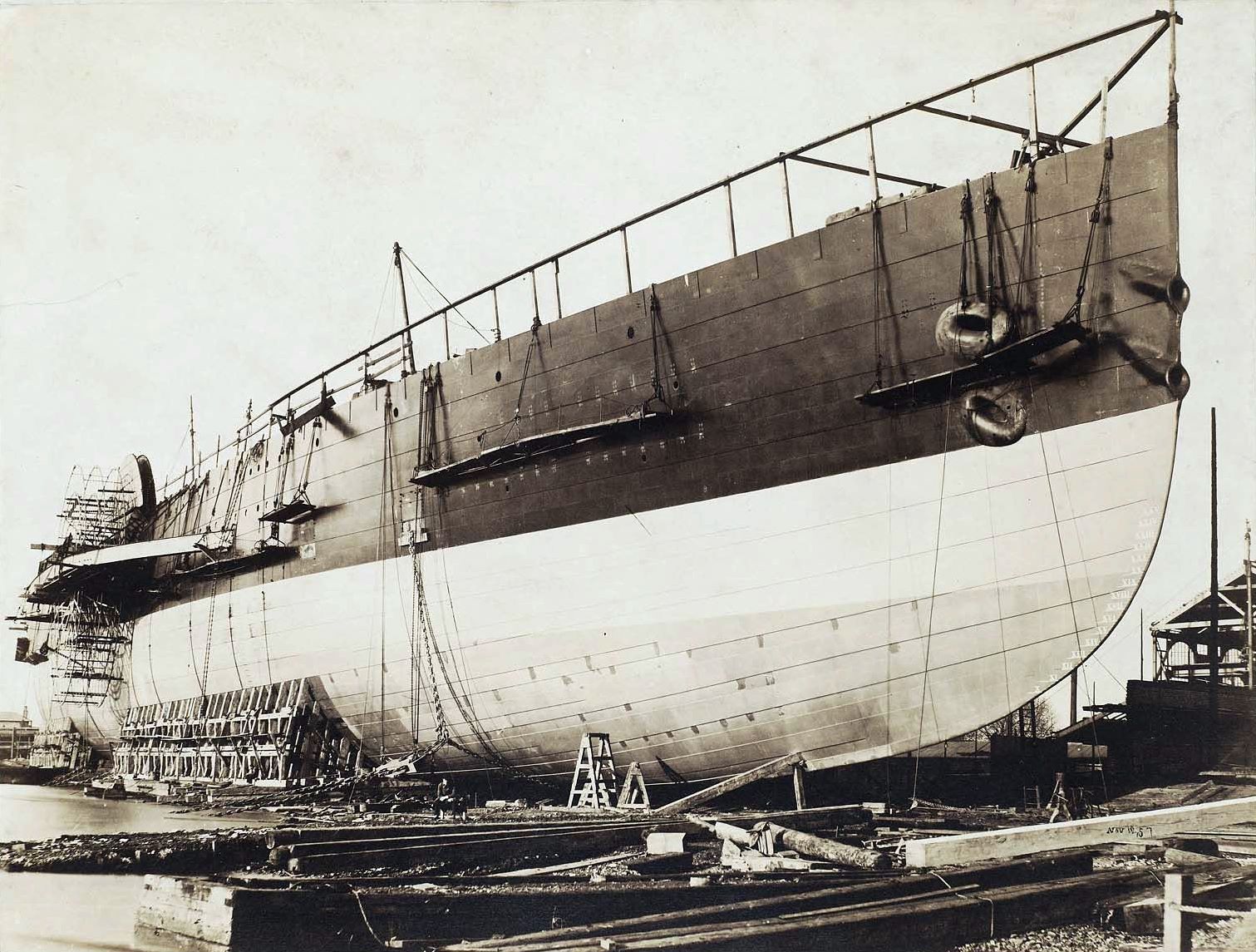
The heavier cable was too much for two warships, but one vessel could take it all. Great Eastern, designed by Isambard Kingdom Brunel with the shipbuilder John Scott Russell and launched on the Thames on 31 January 1858, was 692 feet long, far larger than any other ship of the day. It had failed as a passenger liner. Converted with three large cable tanks and paying-out machinery over the stern, it was the only ship afloat that could carry an entire Atlantic cable.
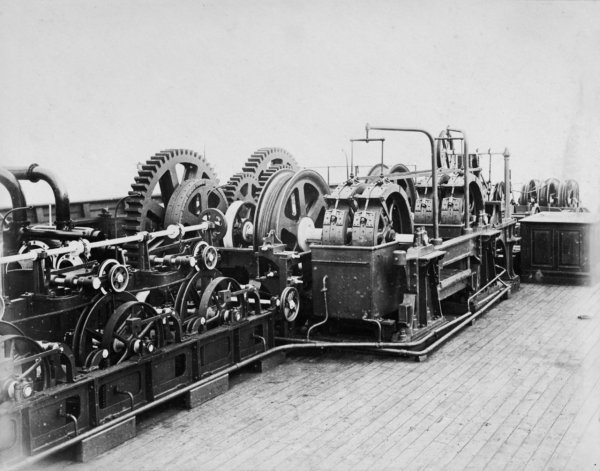
The ship left Valentia in July 1865. The cable was coiled in the tanks, led over sheaves and through a braking mechanism, and the engineers had to keep the tension low enough not to snap it and high enough not to waste cable on the seabed. On 2 August, after about 1,200 nautical miles had been laid, the paying-out gear jammed and the cable broke. The crew spent about two weeks grappling for it in water more than two miles deep, raising it several times, but each time the lifting rope or its shackles gave way. The ship returned to England.
The 1866 crossing and the recovered cable
A new company, the Anglo-American Telegraph Company, financed a second cable. Great Eastern left Valentia on 13 July 1866 and reached Heart’s Content in Trinity Bay, Newfoundland, on 27 July, a voyage of two weeks and about 1,686 nautical miles. The cable was landed and connected to the land lines, and Field sent news of the success from Newfoundland.
The ship then returned to the position of the 1865 break. Grappling in deep water put enormous strain on the gear, since the wire rope had to bear its own weight as well as the cable’s, and the crew repaired capstans and shackles on deck as they worked. The old cable was raised and spliced on 2 September, the remaining distance was laid, and by 8 September both cables were working. Thomson, who had sailed on the 1865 and 1866 expeditions, was knighted in November 1866.
Reading a signal on a long cable
The Morse register and sounder used on land lines needed currents far stronger than a long cable could deliver. Thomson’s mirror galvanometer solved this. A tiny magnet with a light mirror attached hung inside a coil. A lamp shone on the mirror, which reflected a spot of light onto a scale. The faintest current turned the magnet slightly and moved the spot.
Cable signals did not use long and short pulses. The sender reversed the direction of the current instead. Current one way swung the spot to the left, which stood for a dot; current the other way swung it to the right, for a dash. Both elements took the same time, which made best use of a slow line. One clerk watched the spot and called out the letters while another wrote them down. Copying a cable signal was a visual skill and a demanding one.
In 1867 Thomson patented the siphon recorder, in which a fine glass siphon traced a continuous ink line on moving paper, deflected one way or the other by the current. It came into general use on cables in the 1870s and left a written record that could be checked. With the heavier cable and these instruments, the 1866 line carried six to eight words a minute.
What a message cost
Capacity was scarce, and the first tariff reflected it. In 1866 the charge was £20 for a message of up to twenty words, with £1 for each additional word. Users were banks, newspapers, merchants and governments, and they compressed their messages into private commercial codes in which a single word could stand for a whole phrase.
Rates came down within a few years as more cables were laid and companies competed. Every cable that followed used the same principles Thomson had argued for in the 1850s: a heavy conductor, thick insulation, and receiving instruments sensitive enough to read a weak signal at the far end.