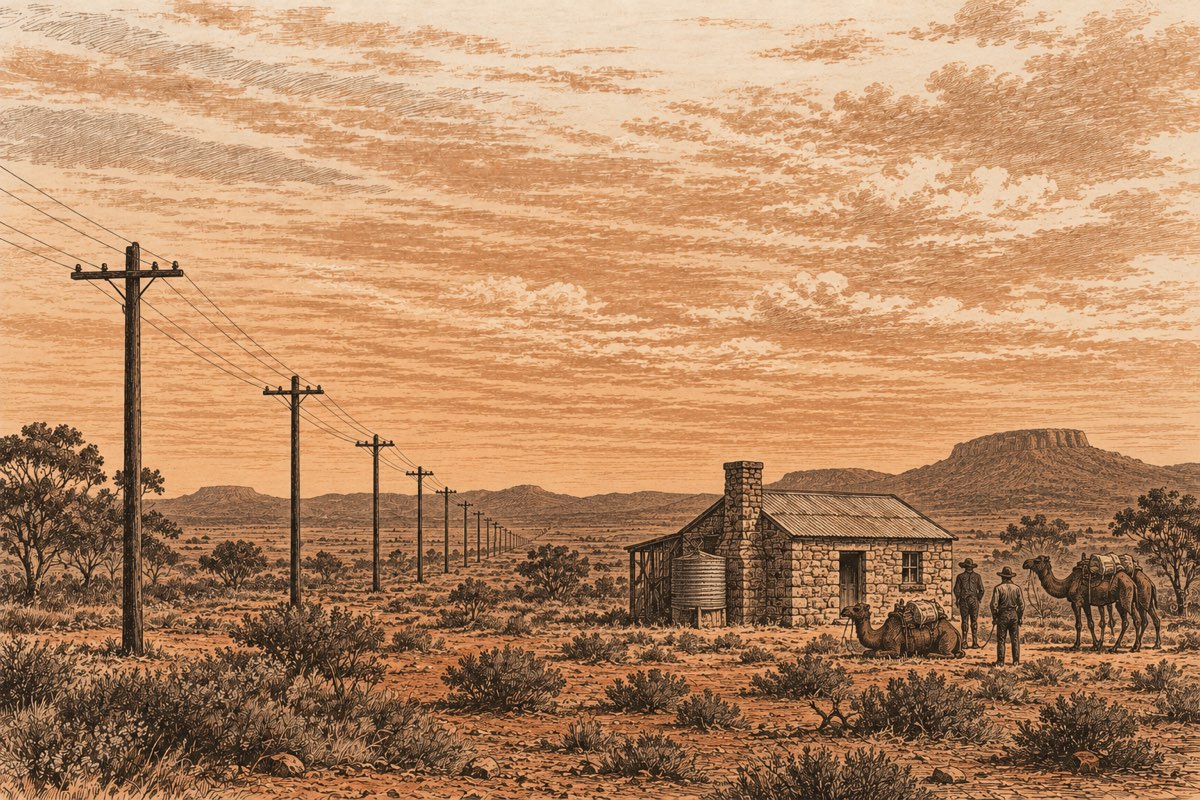
A contract with a deadline
In the late 1860s news from Britain reached the Australian colonies by ship and was weeks old on arrival. A submarine cable was being extended east toward Asia, and the colonies competed to be the place where it would come ashore. South Australia, which then administered the Northern Territory, won the contest by agreeing to build an overland line from the south coast to Port Darwin, where the British-Australian Telegraph Company would land a cable from Java.
The man responsible was Charles Todd, South Australia’s Superintendent of Telegraphs. The route would run about 3,200 kilometres from Port Augusta, at the head of Spencer Gulf, through the centre of the continent to Port Darwin, then called Palmerston. For most of its length it followed the track of John McDouall Stuart, who had crossed the continent from south to north in 1862 and whose maps proved accurate enough for the surveyors to rely on.
Building through the centre
Construction began in 1871 with about 500 men working in three sections: a southern section, a central section and a northern section. The finished line carried about 36,000 poles. Eleven repeater stations were built along it, sited at permanent water and spaced roughly 200 kilometres apart. Each was staffed by operators and linesmen who kept the signal moving and repaired faults.
One of the central stations was built beside a waterhole found in 1871 by the surveyor William Whitfield Mills, who named it Alice Spring after Todd’s wife, Alice. The telegraph station there is the origin of the town of Alice Springs.
The northern section fell behind schedule. The British-Australian Telegraph Company’s cable from Banyuwangi in Java came ashore at Darwin on 19 November 1871, well before the land line was ready.
Riders across the gap
By June 1872 the northern work had reached Daly Waters and the southern wire ended at Tennant Creek, leaving a gap of about 420 kilometres. Messages were carried across it on horseback. Telegrams were keyed to the end of the wire, written out, carried by riders to the other end and keyed onward. On 1 July 1872 one rider, Ray Boucot, covered the whole gap in 131 hours, about 101 of them in the saddle.
The two ends of the wire were joined near Frew’s Ponds, between Daly Waters and Tennant Creek, on 22 August 1872. Messages could now pass by wire from Adelaide to Darwin. The undersea cable had failed, however, and it was not working again until 21 October 1872. From that date telegrams passed between Australia and Britain in hours rather than the weeks a ship took.
Life on the line
The repeater stations were isolated postings. Operators lived at them with linesmen and spent their working day sending and receiving Morse and keeping the batteries and instruments in order. Traffic for the whole continent passed through their hands, and a fault anywhere along the line stopped the service until a linesman rode out to find it.
The line also ran through the country of many Aboriginal peoples, and the stations, waterholes and stock that came with it disrupted their lives and land. On 22 February 1874 Kaytetye men attacked the Barrow Creek telegraph station, killing the stationmaster James Stapleton and the linesman John Frank. Mounted Constable Samuel Gason led punitive expeditions in response. His official report recorded 11 Aboriginal deaths; other accounts put the number much higher, and historians continue to document killings along the route.