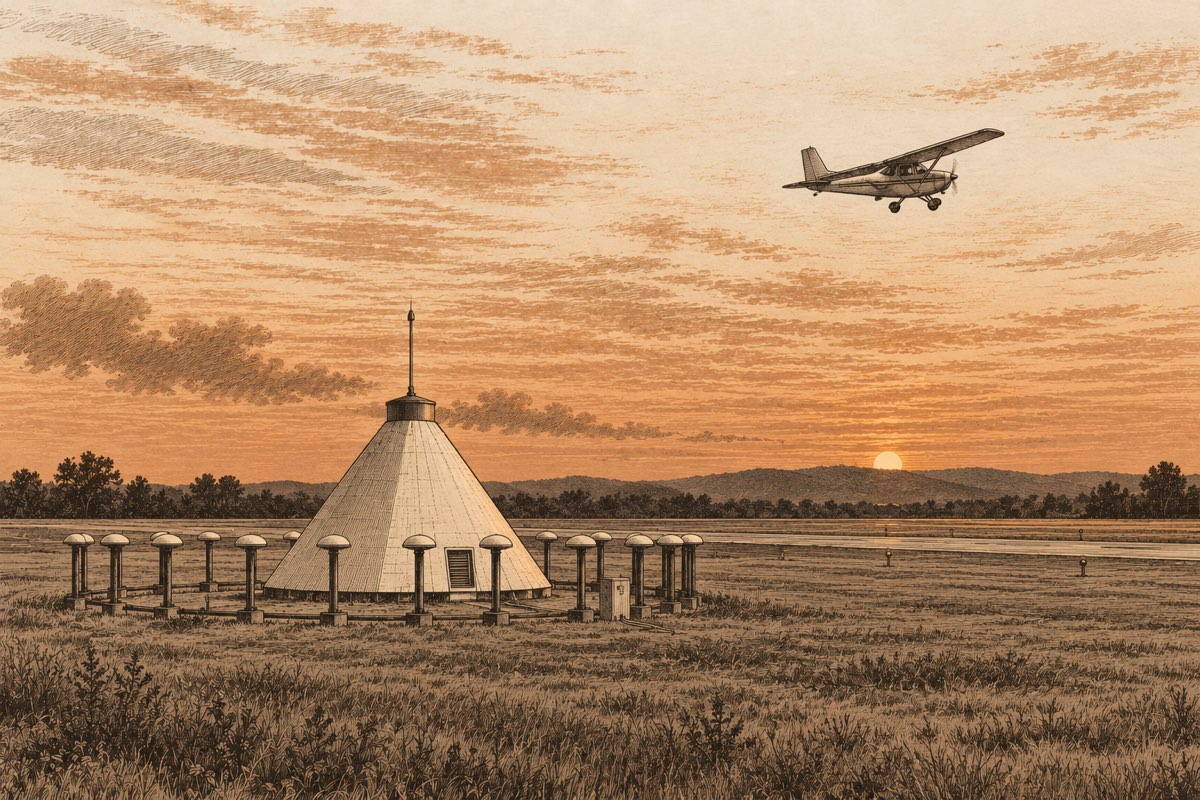
The A and N radio range
In the late 1920s the United States began building radio aids for flying in cloud and at night. The main system was the low-frequency radio range, sometimes called the four-course range or A–N range. Each station transmitted the Morse letter A (·−) into two opposite quadrants around the station and the letter N (−·) into the other two. Along the boundaries between quadrants the two signals overlapped, and because A and N are mirror images, their dots and dashes interlocked to form a steady, unbroken tone.
A pilot flying by the range listened through headphones. A steady tone meant the aircraft was on one of the four courses that led to or from the station. If an A or an N began to stand out from the tone, the aircraft had drifted into that quadrant, and the pilot turned back toward the steady signal. Directly over the station the signal faded briefly into a “cone of silence”. Every so often the range broke off the A and N to send its own identifier in Morse, so the pilot could confirm which station he was hearing. The ranges were the backbone of instrument flying in the United States into the 1940s, and some remained in service for decades after.
The beacons that replaced it
From the late 1940s the VHF omnidirectional range, or VOR, took over as the main navigation aid. A VOR gives a bearing to the station on an instrument in the cockpit, so the pilot no longer has to interpret sounds. Lower-frequency nondirectional beacons, or NDBs, which an aircraft’s direction finder points toward, were also widely used, and the instrument landing system, or ILS, guides aircraft on the final approach to a runway.
All of these aids continued to identify themselves in Morse. A VOR sends a three-letter identifier, often related to the name of the place. The Federal Aviation Administration’s Aeronautical Information Manual states that “the only positive method of identifying a VOR is by its Morse Code identification or by the recorded automatic voice identification”. NDBs, other than compass locators, transmit a continuous three-letter identifier in code. An ILS localizer identifies itself with four letters, the first always I (··), followed by three letters for the airport or runway.
Listening to the ident
Pilots are trained to tune a navigation aid and then listen to its identifier before relying on it. Aeronautical charts print the identifier next to each facility both as letters and in dots and dashes, so a pilot does not need to know Morse fluently to match the sound to the chart. The check guards against having tuned the wrong frequency, or receiving a distant station on the same frequency.
The identifier also tells the pilot whether a facility is working normally. During maintenance, the manual says, a VOR “may radiate a T-E-S-T code” (− · ··· −) “or the code may be removed”. A facility that is transmitting a signal but no identifier should not be used for navigation, because the signal may be unreliable. The manual also notes that the direction-finding receivers used with NDBs have no flag to warn of erroneous bearings, so pilots are told to monitor the identifier to detect interference.
Beacons today
Satellite navigation has reduced the need for ground beacons. In 2016 the FAA set out a plan to decommission about a third of the VORs in the United States and keep a Minimum Operational Network of about 590 stations as a backup if GPS is unavailable. The stations that remain still send their identifiers in Morse, and new pilots still learn to check them.
The identifiers reach people outside aviation as well. Rush’s instrumental “YYZ” opens with the Morse rhythm of the letters YYZ, the identifier of Toronto’s Pearson airport, which the band heard from the cockpit on a flight into the city.