A task force that could not transmit
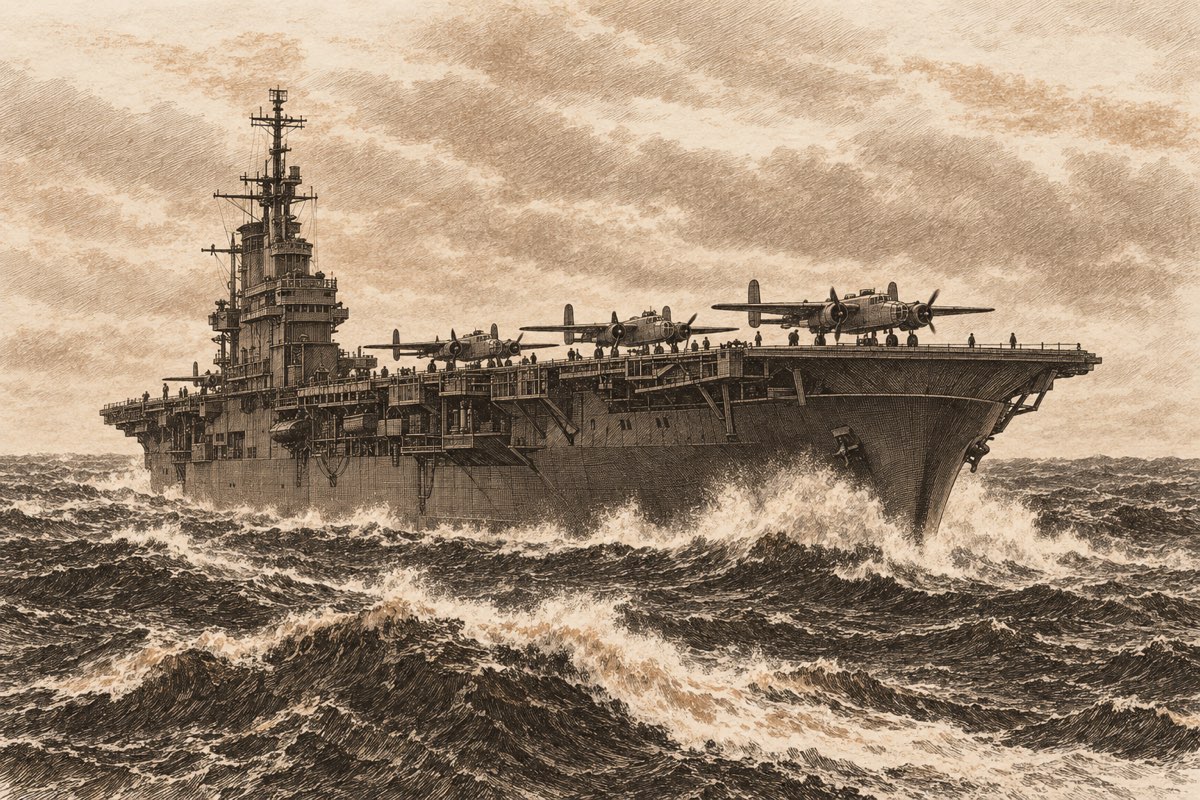
In April 1942, four months after Pearl Harbor, the US Navy sent two aircraft carriers towards Japan carrying sixteen US Army Air Forces B-25 bombers under Lieutenant Colonel James H. Doolittle. The bombers were loaded onto USS Hornet at Alameda, California, and Hornet sailed on 2 April. On 13 April, north of Midway, she joined USS Enterprise and its escorts under Vice Admiral William F. Halsey, who took command of the combined force.
The plan depended on surprise. Any radio transmission from the ships could be picked up by Japanese listening stations and give away the force’s position. The task force therefore kept radio silence: its receivers listened, but its long-range transmitters stayed off. Messages between ships went by flag hoist, by semaphore and by signal lamps flashing Morse code, which could be read by ships in company but could not be heard over the horizon. Hornet’s action report records that the ships of the force were told the purpose of the mission by semaphore.
The bombers themselves were stripped for range. Their long-range liaison radio sets were removed before the mission to save weight, so once airborne the crews could listen but not call anyone.
The picket line
Japan had anticipated an approach from the east and kept a line of small patrol boats, many of them requisitioned fishing vessels, stationed far out to sea. On the morning of 18 April 1942 the task force ran into this line. At 07:38 Hornet logged an enemy patrol craft of about 150 tons at a range of 20,000 yards. It was the picket boat No. 23 Nitto Maru, and before it was sunk it sent a radio report of what it had seen.
The light cruiser USS Nashville opened fire at 07:55 and took nearly half an hour to sink the small boat, while aircraft from Enterprise attacked other picket boats in the area. Whatever the American ships did now, the Japanese navy had to be assumed to know that carriers were approaching.
An early launch
The original plan had been to launch the bombers about 400 miles from Japan, late in the day, so that they would bomb at night and reach airfields in China in daylight. The force was now roughly 650 nautical miles from Japan, and it was morning. Halsey ordered the launch. Hornet’s action report records Doolittle’s aircraft leaving the deck at 08:25 and the sixteenth and last at 09:20. The carriers then turned away and left the area.
Why radio silence mattered
The bombers reached Japan around midday and attacked targets in Tokyo, Yokohama, Nagoya, Kobe and other cities. One crew later reported that, as they approached the coast, a Japanese radio broadcast of music was interrupted by an alarm and a shouted warning. Because of the longer flight, none of the aircraft reached the planned airfields in China. Fifteen crews crash-landed or bailed out over China, and one landed near Vladivostok in the Soviet Union, where the crew was interned. Of the eighty men, three were killed in the crash-landings and bail-outs, and eight were captured by the Japanese, who executed three of them. Most of the rest reached safety with the help of Chinese civilians and soldiers.
The raid caused little physical damage, but it showed that Japan could be reached, and Japanese planners responded by pushing their defensive perimeter outward, a decision that led towards the Battle of Midway in June. The radio discipline of the task force kept it hidden until it met the picket line. The transmission that changed the plan on the morning of 18 April came from the Japanese boat that saw it.