Mount Clemens, 1862
Thomas Edison grew up in Port Huron, Michigan, and as a teenager sold newspapers and snacks on the Grand Trunk Railway trains between Port Huron and Detroit. In August 1862, at the station in Mount Clemens, he pulled Jimmie MacKenzie, the young son of the station agent J. U. MacKenzie, out of the path of a train. In gratitude the agent taught Edison telegraphy. Edison was fifteen.
He began working part-time in the telegraph office at Port Huron, which was in a jewellery shop. The shop’s proprietor, Micah Walker, later said Edison was no good at waiting on customers and spent his spare time taking apart and experimenting with the telegraph equipment.
A travelling operator
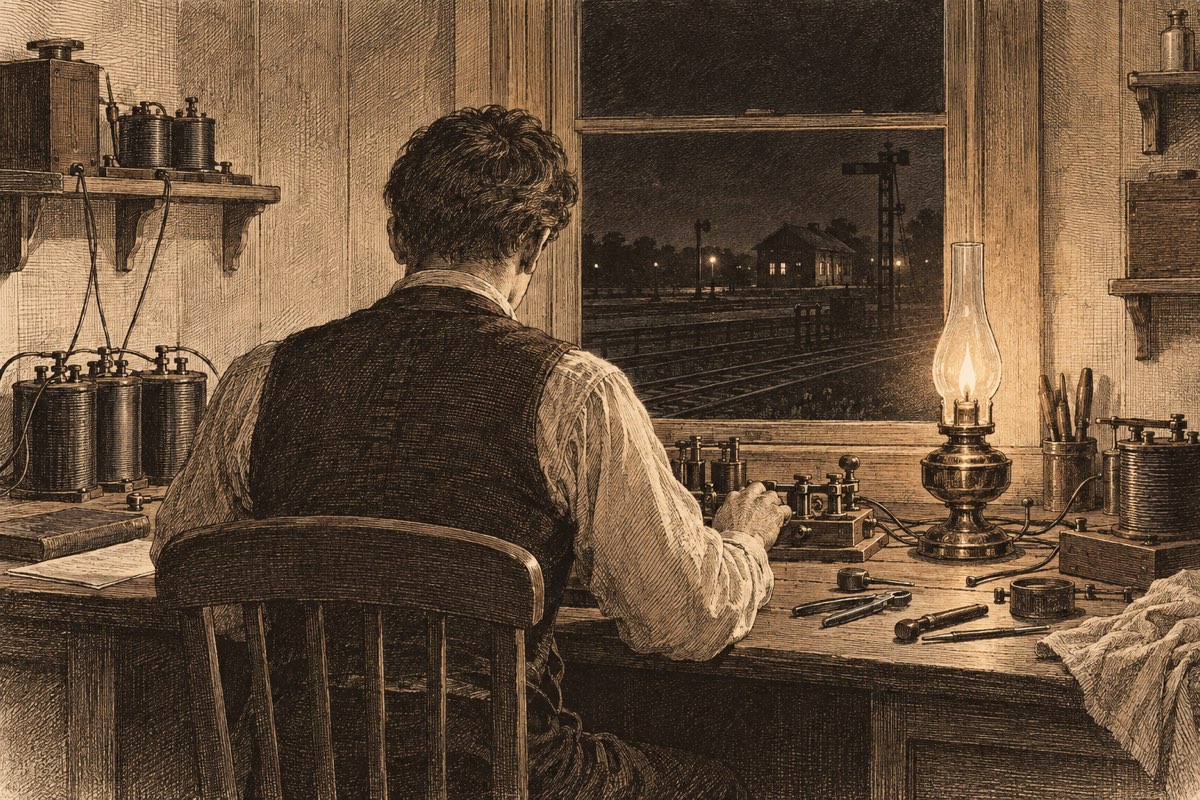
In 1863 Edison took a job as night operator for the Grand Trunk Railway at Stratford Junction, Ontario. He later said the night shift suited him because he had the whole day to himself. The job ended after he failed to hold a train as ordered and two trains came close to a collision on the single track; he was dismissed.
For the next five years Edison worked as what operators called a tramp telegrapher, moving from office to office wherever there was work. He was employed at Adrian, Michigan, on the Lake Shore and Michigan Southern Railroad; at Fort Wayne and Indianapolis in Indiana; at Cincinnati; at Nashville; and at Louisville, Kentucky.
Much of his work was receiving news copy, long reports sent at speed over press wires that had to be written out by hand as they arrived. At Indianapolis he built what the Thomas Edison Papers project describes as his first genuine invention, a practice instrument that recorded Morse signals on paper tape at normal speed and played them back more slowly so that an operator could transcribe them. In Cincinnati in 1867 he set up a small workroom, began notebook experiments on duplex telegraphy, which sends two messages over one wire at once, and drew designs for automatic repeaters.
Boston and the first patent
In April 1868 Edison moved to Boston to work nights at the main Western Union office, receiving Associated Press copy on the main press wire from New York, and spent his days on his own projects. On 28 October 1868 he applied for a patent on an electric vote recorder that would let legislators record a yes or no from their desks. United States patent 90,646 was granted on 1 June 1869. Congress showed no interest and the device was never made in quantity. In January 1869 Edison left Western Union to work as an inventor.
His telegraph inventions paid for his later work. The Gold and Stock Telegraph Company, a Western Union affiliate, bought his improvements to the stock ticker, and he developed the Universal Stock Printer in 1871. In 1874 he devised the quadruplex telegraph, which carried four messages on one wire, two in each direction, and sold rights to it to Jay Gould’s Atlantic and Pacific Telegraph Company.
Dot and Dash
Edison kept the operator’s habits. His first two children were Marion, born in 1872, and Thomas Jr., born in 1876; at home he called them Dot and Dash. According to Edison family accounts, he taught Morse code to Mina Miller, who became his second wife, and proposed to her by tapping the question in code on her hand; she tapped back her answer. They married on 24 February 1886.
Edison was hard of hearing from his youth. He gave different explanations for it at different times, and the cause is still uncertain; a childhood illness and repeated ear infections are the most likely explanation.