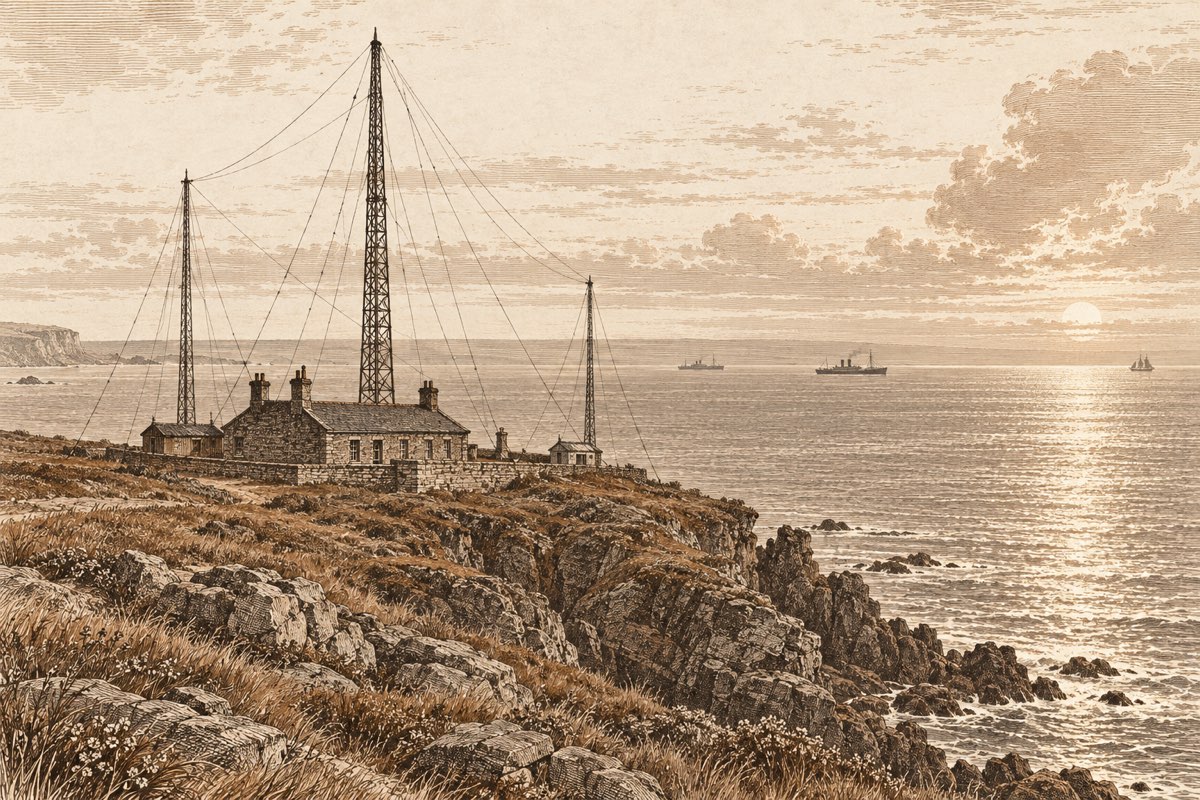
Six hundred metres
Early radio was described by wavelength rather than frequency. The first International Radiotelegraph Convention, signed in Berlin in 1906 and in force from 1908, gave ships and coast stations two wavelengths for public correspondence, 300 metres and 600 metres. The London convention of 1912 made 600 metres, which is 500 kHz, the main frequency for calling and distress at sea.
From then until the 1990s, 500 kHz was where a ship in trouble sent SOS and where every ship’s operator and coast station kept watch. It was a calling frequency. Two stations made contact there and then moved to a working frequency to pass their traffic, so that the calling channel stayed clear.
The silent periods
To give weak distress signals a chance of being heard, international rules set two silent periods every hour, from 15 to 18 minutes past and from 45 to 48 minutes past. During those minutes all stations stopped transmitting on the 500 kHz band except for distress traffic, and operators listened. The clock in a ship’s radio room had those two sectors painted red on its face so the operator could see them at a glance.
The rules also set out signals of lower priority than distress. XXX, sent three times before the call, was the urgency signal, used for a message about the safety of a ship or a person that fell short of distress. TTT, sent three times, was the safety signal, used before navigational and weather warnings.
The auto alarm
Many cargo ships carried only one radio officer, who could not listen around the clock. The answer was the auto-alarm, a receiver that stayed tuned to 500 kHz while the operator was off watch and recognised a specific signal: twelve dashes, each four seconds long, separated by spaces of one second. A ship in distress sent this alarm signal before her SOS. Hearing a few correctly timed dashes in a row was enough to make the device ring bells in the radio room, in the operator’s cabin and on the bridge.
The alarm signal was chosen because it was unlike anything in ordinary Morse traffic. A machine could detect long, regular dashes reliably through static, where it could not have read SOS itself.
Other frequencies
Signals on 500 kHz carried several hundred miles by day and farther at night, but not across oceans. Longer-range traffic went on high-frequency maritime bands, and the procedure there used the same Morse and the same Q codes. Survival craft radios used 500 kHz and 8364 kHz, a high-frequency channel that lifeboats could use to reach searching ships and aircraft at long range.
When the Global Maritime Distress and Safety System became mandatory in 1999, ships were no longer required to keep the Morse watch on 500 kHz, and coast stations closed their watches over the following years. The band did not stay quiet. In 2012 the World Radiocommunication Conference gave radio amateurs a small secondary allocation at 472–479 kHz, close to the old distress frequency, after experimental stations had shown it could be used without interference. Amateurs use it, among other modes, for Morse.