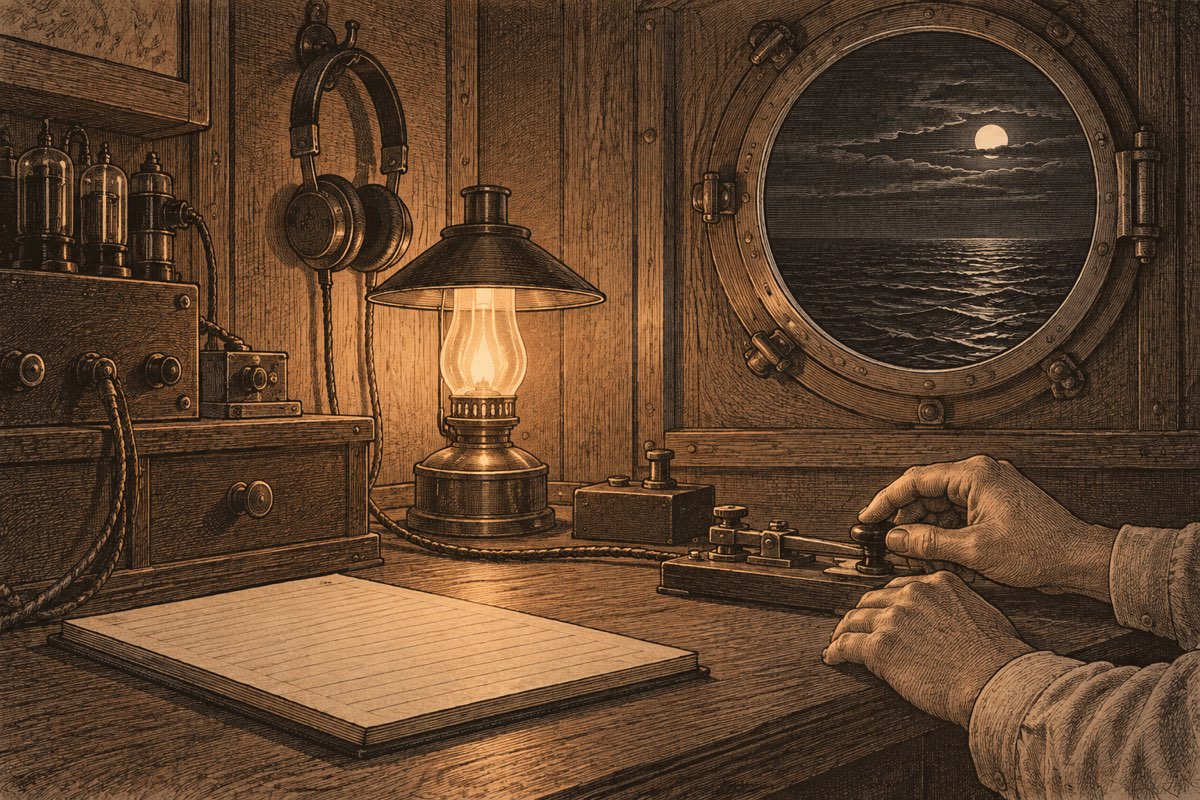
One man and one set
Harold Cottam was twenty-one years old in April 1912, a Marconi operator from Liverpool with about three years’ experience. He had joined the Cunard liner Carpathia in February, on her run between New York and the Mediterranean. Asked by the United States Senate inquiry how many operators the ship carried, he said: “Only one man, sir.”
A single operator could not keep a watch around the clock. Cottam worked long hours and then slept, and while he slept the Carpathia was out of contact. The rules of the time required no more.
A message for the Titanic
On the night of 14 April the Carpathia was southeast of the Titanic, bound for Gibraltar. Cottam’s duties for the day were over, but he was still at the set. He had been copying the news broadcast from the Marconi station at Cape Cod, a service sent out for ships’ passengers, and then listened for the Parisian to confirm an earlier exchange. Having heard that Cape Cod had messages waiting for the Titanic, he called her to tell her so.
He testified that the reply was: “Come at once. It is a distress message; C.Q.D.” with the Titanic’s position. Captain Arthur Rostron told the inquiry that Cottam had been in his cabin, not on official duty, listening while he undressed, and that ten minutes later he would have been asleep. Cottam took the message to the bridge and to Rostron. Rostron testified that he was told at 12:35 a.m., and that the Titanic lay “north 52 degrees west true 58 miles from my position.”
Rostron turned the ship and pushed her to the best speed she could make. Cottam passed the Carpathia’s position to the Titanic on paper written by the captain, and received the reply “Received.” In later exchanges the Titanic reported that she was going down by the head. The Carpathia reached the area at about 4 a.m. and took aboard the first lifeboat at 4:10. By then the Titanic had sunk. About 705 people were taken from the boats.
Days at the key
Once the survivors were aboard, the Carpathia’s wireless room became the only link between the rescue and the shore. Cottam spent the next days sending the names of survivors and their private messages, and receiving a flood of inquiries from relatives, newspapers and shipping offices. Harold Bride, the Titanic’s junior operator, who had been injured and rescued from an overturned boat, came to the wireless room and helped him.
Captain Rostron directed that official messages and survivors’ messages take priority over press requests. Newspapers in New York complained that the Carpathia was refusing them, and American officials were frustrated by the lack of replies. Cottam and Bride sent what they could with one set and two exhausted men, and the ship reached New York on the evening of 18 April.
The inquiry’s questions
Both the American and British inquiries questioned Cottam closely: when he heard the call, what he sent and what he received. The Senate investigation also examined arrangements made after the Carpathia’s arrival for the operators to sell their accounts to the New York Times, which Guglielmo Marconi, as head of the American company, had approved.
The inquiries turned the circumstances of Cottam’s night into a regulatory point. The Carpathia heard the call because one man stayed at his set after his work was done. Within months the United States required large passenger ships to carry two operators and keep continuous watch, so that rescue no longer depended on such chances.