A collision in fog
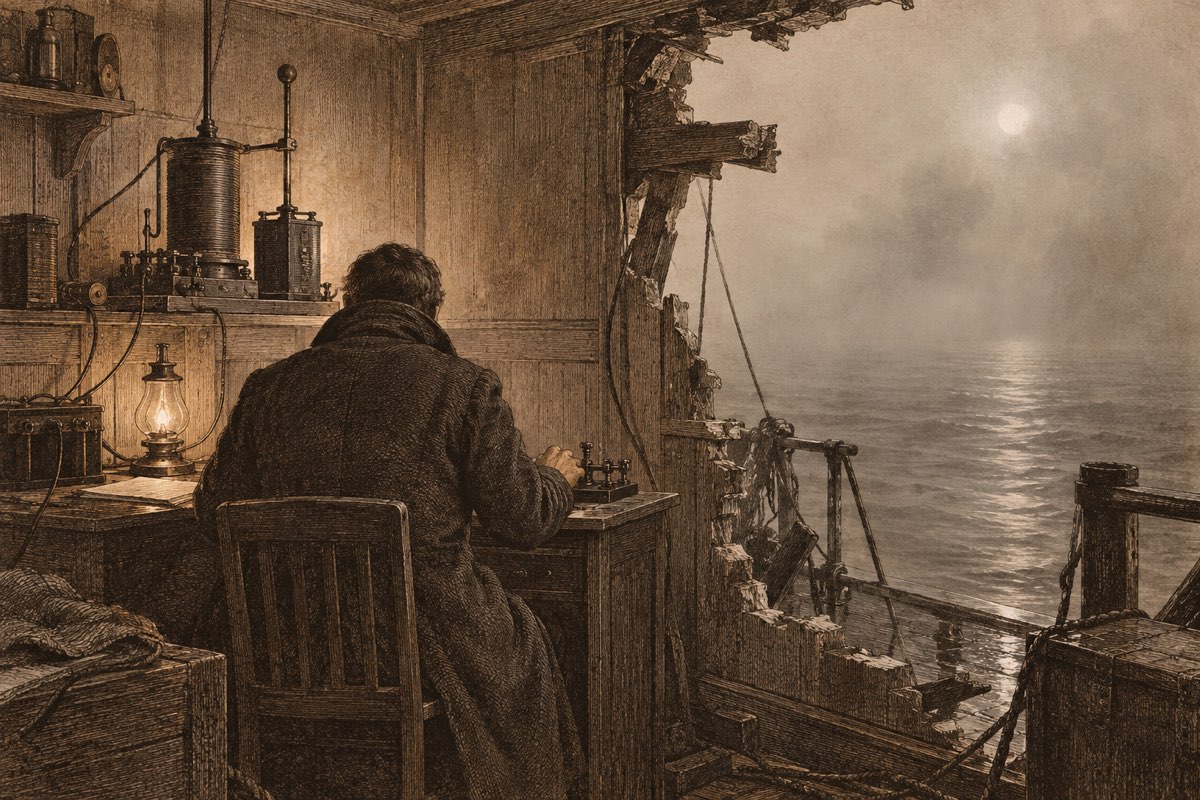
Early on the morning of 23 January 1909 the White Star liner Republic was outbound from New York for the Mediterranean, steaming through dense fog south of Nantucket. At about 5:47 a.m. she was struck amidships by the Italian liner Florida, inbound for New York with emigrants, many of them refugees from the Messina earthquake of the previous month. The Florida’s bow cut deep into the Republic’s side. Water flooded her engine room, and the ship lost her main electrical power.
The Republic’s wireless operator was Jack Binns, a young Englishman employed by the Marconi company. His wireless cabin was damaged in the collision, and with the dynamos stopped his transmitter had lost its ordinary supply. He rigged it to run from emergency batteries and began calling.
CQD to Siasconset
Binns sent CQD, the call the Marconi company had prescribed for its operators since 1904: the general call CQ followed by D for distress. The international convention that made SOS the distress signal had come into force only six months earlier, and Marconi operators still used CQD as a matter of habit and company practice.
The nearest shore station was the Marconi station at Siasconset on Nantucket, whose call sign was MSC. Its night operator, Jack Irwin, picked up the weak signal and passed word of the collision to other stations and ships. The Republic’s signal could not reach far on battery power, so Siasconset served as a relay between the sinking ship and the vessels coming to help. The reconstructed log of the exchanges gives the Republic’s call letters as MKC. Binns said afterward that he could keep no written log in the dark cabin, so the timed versions of the messages that circulated later are reconstructions rather than a record made at the key.
The Baltic finds the ships
The White Star liner Baltic, under Captain J. B. Ranson, was inbound to New York and turned toward the position given. In the fog she could not simply steam to the spot. Over the course of the day she worked her way toward the two damaged ships using wireless contact, her submarine bell receivers and soundings, and reached them in the evening. The United States revenue cutter Gresham also came out.
The Republic’s passengers had already been moved to the Florida, which was damaged but afloat. The Baltic then took on the passengers of both ships, more than fifteen hundred people, transferred by lifeboat at night in an open sea. The Republic was taken in tow but sank on 24 January. The deaths in the disaster were all caused by the collision itself, and accounts put them at five or six.
An operator becomes famous
Newspapers on both sides of the Atlantic treated the rescue as proof of what wireless could do at sea. Binns returned to New York to a public welcome, was offered stage engagements, and became known as “CQD Binns.” A magazine article on wireless operators published that April described how he had “stuck to his instrument” through the emergency and noted that a British operator of his standing earned about twelve dollars a week.
The case also showed the limits of the arrangement. The Republic had one operator, and her set depended on batteries once the dynamos failed. Its range on emergency power was short, so the rescue depended on a shore operator who happened to be listening and on other ships that carried wireless at all. Those questions, about the number of operators, continuous watch and emergency power, were the ones legislators returned to after the Titanic three years later.