Listening to the High Seas Fleet
By 1916 the German High Seas Fleet and the British Grand Fleet both depended on wireless telegraphy. Ships carried spark transmitters and sent Morse in enciphered naval codes. Every transmission could be heard by the other side, and the British had built two tools to exploit that.
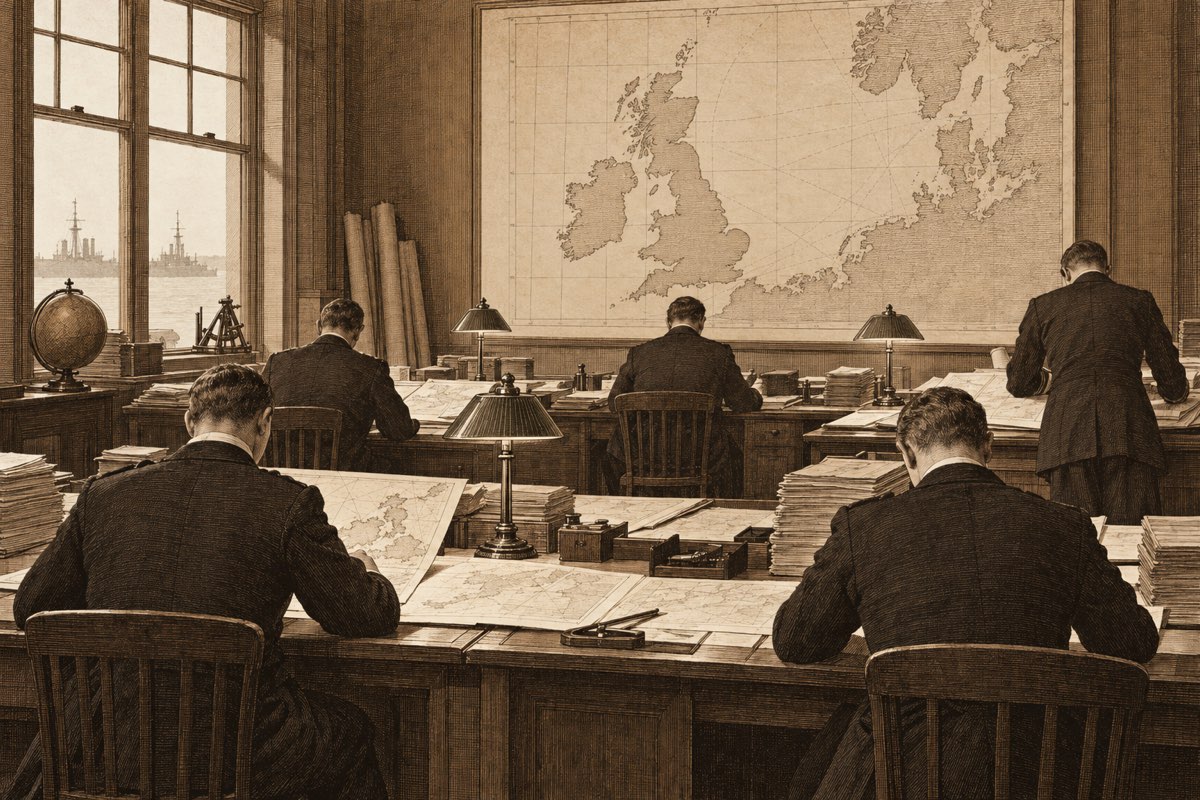
The first was Room 40, the Admiralty’s codebreaking section, set up in late 1914. Its staff had copies of the main German naval codebooks, captured or recovered early in the war, and they read a large share of German naval signals. The second was a chain of wireless direction-finding stations along the east coast of England, built from 1915 by the Marconi Company and its engineer H. J. Round, and linked to an intercept station at Hunstanton in Norfolk that had been listening to German traffic since late 1914. By taking bearings on the same transmission from several stations, operators could plot roughly where a German ship or shore station was.
Sailing before the enemy
At the end of May 1916 the volume and content of German signals showed Room 40 that a major operation was being prepared. On the evening of 30 May the Admiralty ordered the Grand Fleet under Admiral Sir John Jellicoe to sea from Scapa Flow and the Cromarty Firth, and Vice-Admiral Sir David Beatty’s battlecruisers from Rosyth. The British fleet was at sea before the German fleet left the Jade estuary in the early hours of 31 May.
The call sign DK
The German fleet commander, Vice-Admiral Reinhard Scheer, used the call sign DK. When the fleet went to sea, German procedure transferred that call sign to the wireless station at Wilhelmshaven, and the flagship used another. Room 40 knew this.
On the morning of 31 May the Director of the Operations Division, Captain Thomas Jackson, came to Room 40 and asked where the call sign DK was. He was told, correctly, that direction finding placed it at Wilhelmshaven. He did not say why he was asking, and he was not told that the call sign no longer meant Scheer was there. The Admiralty then signalled Jellicoe that, according to direction finding, the German flagship was still in harbour. A few hours later, in the afternoon, Beatty’s battlecruisers met the German battlecruisers and then the entire High Seas Fleet.
The night after the battle
After the main fleets fought in the early evening, the Germans turned for home during the night. Room 40 decrypted German signals that pointed to Scheer’s route back towards the Horns Reef, including a request he sent at 21:06 for airship reconnaissance off the Horns Reef at dawn. Of sixteen decrypts passed to the Operations Division that night, only three reached Jellicoe, and the airship request was not among them. Jellicoe, who had been misled once that day, did not place much trust in what the Admiralty did send. The German fleet passed behind the British in the darkness and reached harbour.
Britain lost more ships and men than Germany at Jutland but kept control of the North Sea. The wireless intercepts and direction-finding bearings had been accurate; the errors were in how the operations staff asked Room 40 for information and how the answers were passed to the fleet.