A room next door
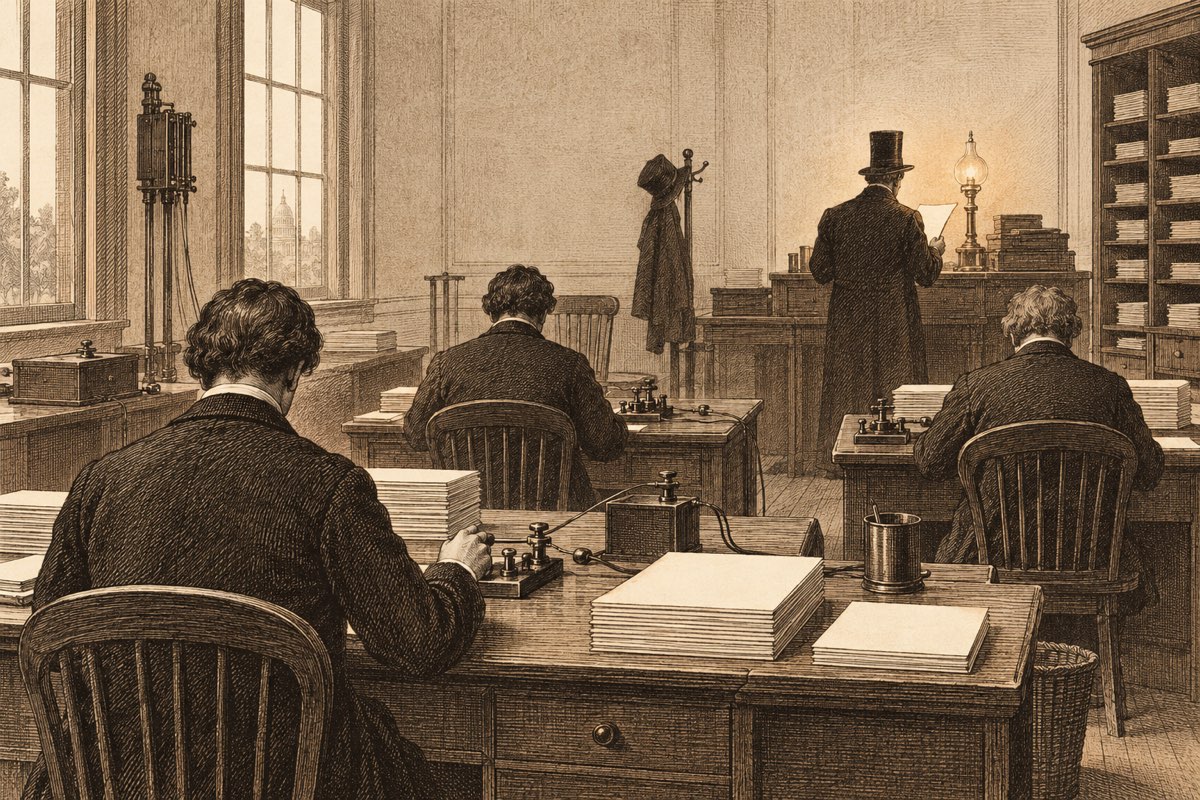
When the Civil War began in April 1861, the President of the United States had no telegraph in the White House. Military messages came over commercial lines, through several offices, and reached the government by messenger. In early 1862, after Edwin M. Stanton became Secretary of War, the War Department gathered the military telegraph into one office in its own building, a short walk west of the White House. The office occupied the old library next to Stanton’s rooms, and from March 1862 every dispatch to and from the armies passed through it.
The arrangement put the operators within a few yards of the Secretary of War and a few minutes’ walk from the President. Lincoln began to come over in person to read the traffic rather than wait for it to be carried to him.
The operators
The office was run by Thomas T. Eckert, who held a commission in the army but had come to the work from the commercial telegraph companies. Three young operators, David Homer Bates, Albert B. Chandler and Charles A. Tinker, worked the cipher desk, turning incoming messages back into plain English and putting outgoing ones into cipher. All of them were telegraphers by trade. In the American practice of the time they read incoming Morse by ear from a sounder, writing down the words as the clicks came in rather than reading marks from a paper tape.
Bates later wrote the fullest account of the office, Lincoln in the Telegraph Office, published in 1907. It is a memoir written more than forty years after the events, and it is the source of most of the stories told about Lincoln’s visits.
Reading the drawer
According to Bates, copies of the day’s messages were kept in a drawer of the cipher desk. Lincoln would sit and read through them in order, starting from the point he had reached on his previous visit. When he came to messages he had already seen, he would say that he was “down to raisins”, a phrase he explained with a story about a child who had eaten raisins last.
Lincoln also wrote telegrams of his own there, in his own hand, to generals in the field. The Library of Congress holds many of them among his papers. They are often short and direct: requests for news, questions about where an army was, and instructions. The telegraph let the President speak to a commander on the same day, and sometimes within the hour, which no earlier American president had been able to do in wartime.
The Emancipation Proclamation draft
Eckert told Bates that during the summer of 1862 Lincoln spent time at Eckert’s desk writing a document on sheets of foolscap, a few lines at a time, over several weeks, and asked him to keep the pages locked away between visits. When it was finished, Lincoln told him it was an order freeing the slaves in the rebel states. This is Eckert’s recollection as reported by Bates, not a contemporary record, but historians generally accept that Lincoln worked on the preliminary proclamation in the quiet of the telegraph office, away from callers at the White House.
Long nights
During the major battles Lincoln stayed in the office late into the night, waiting for messages from the front. On the night of the 1864 presidential election, 8 November, he followed the returns there as the operators received them from the states. Bates also records that Lincoln visited on 14 April 1865, the day he was shot at Ford’s Theatre.
For three years the President read most of his news of the war in that small room, from operators who copied the messages by hand as they arrived.