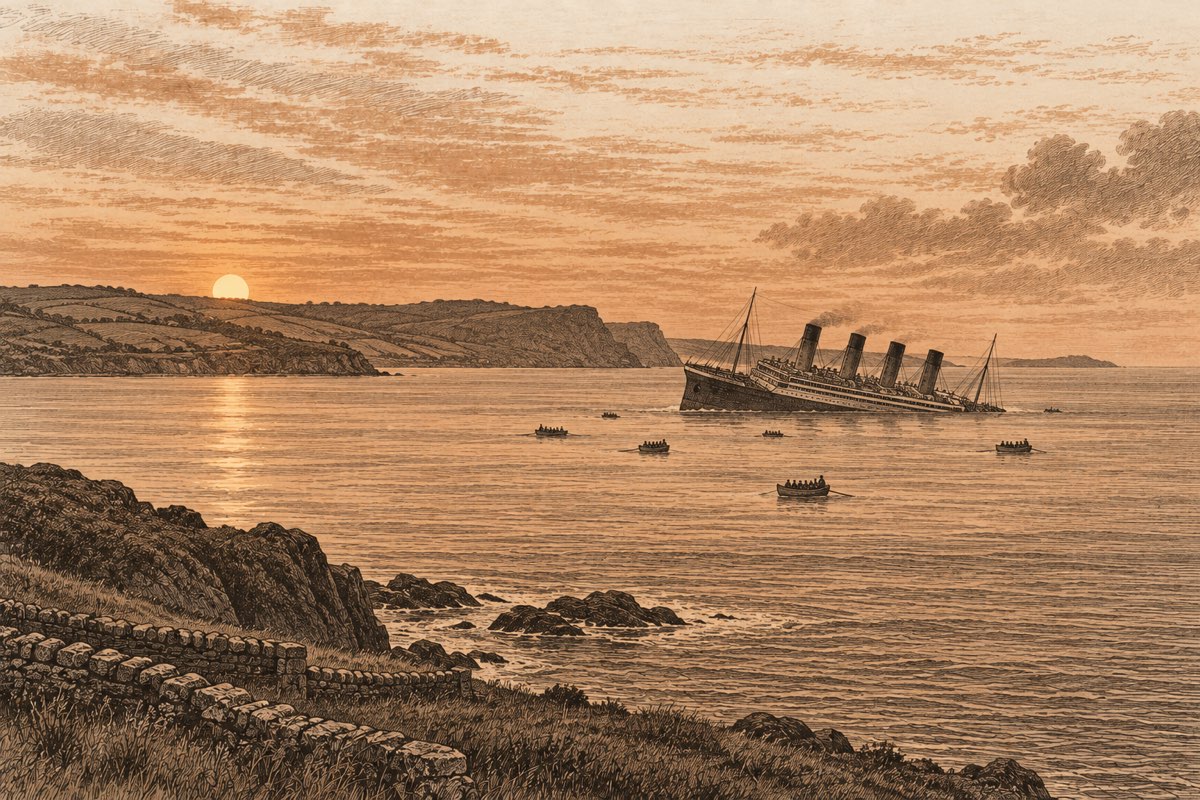
Off the Old Head of Kinsale
On the afternoon of 7 May 1915 the Cunard liner Lusitania was nearing the end of a crossing from New York to Liverpool, steaming along the south coast of Ireland. At about 2:10 p.m. she was struck by a torpedo fired by the German submarine U-20. She listed heavily to starboard and sank in about eighteen minutes, about ten miles south of the Old Head of Kinsale. Of the 1,962 people aboard, 1,198 died.
The ship carried two Marconi operators, Robert Leith, the senior, and David McCormick. Both survived. Leith’s evidence to the British Wreck Commissioner’s inquiry in June 1915 is the main first-hand account of what the wireless room did.
What was sent
Leith told the inquiry he was having his meal in the after dining saloon on D deck when the torpedo struck, and went straight to the wireless cabin. He sent SOS and the words “Come at once – big list”, with the position given as off the Old Head of Kinsale. An officer then gave him a more precise position, and he sent “10 miles south of the Old Head of Kinsale.” He said the messages were acknowledged “immediately by a wireless coast station,” and that he heard other stations reply but could not read them for the noise around him.
Three or four minutes after the torpedo hit, the ship’s main electrical supply failed. Leith switched to the emergency set, which was kept in the wireless cabin, and went on sending. He stayed at the key “until just a few moments before the ship sank.” Distress procedure at the time was simple: the SOS signal, the ship’s call letters, the position and the nature of the danger, repeated for as long as possible so that any station that caught part of it could fill in the rest. Period station lists give the Lusitania’s Marconi call letters as MFA.
Help from Queenstown
The call reached the naval headquarters at Queenstown, now Cobh, farther east along the same coast. Vice-Admiral Sir Charles Coke sent every small vessel he had: tugs, trawlers, fishing boats and the local lifeboat. Fishing boats already near the scene picked up some of the survivors. Most of the rescue craft took two hours or more to arrive, and by then many of the people in the water had died of cold or drowning.
The ship listed so far, so quickly, that only six of her forty-eight lifeboats were launched successfully. The wireless made the position known at once, but the ship sank in about eighteen minutes, before most rescuers could arrive.
Wireless in wartime
The Lusitania was sailing under wartime conditions. Germany had declared the waters around Britain and Ireland a war zone in February 1915, and the Admiralty sent warnings of submarine activity to merchant ships by wireless. The Lusitania had received such warnings on 6 and 7 May. Wireless at sea had become an instrument of naval control as well as of safety, and the same operators who carried passengers’ messages also took down the Admiralty’s coded instructions.
The British inquiry, presided over by Lord Mersey, who had also led the Titanic inquiry, placed the blame for the sinking on the submarine’s commander and the German government.