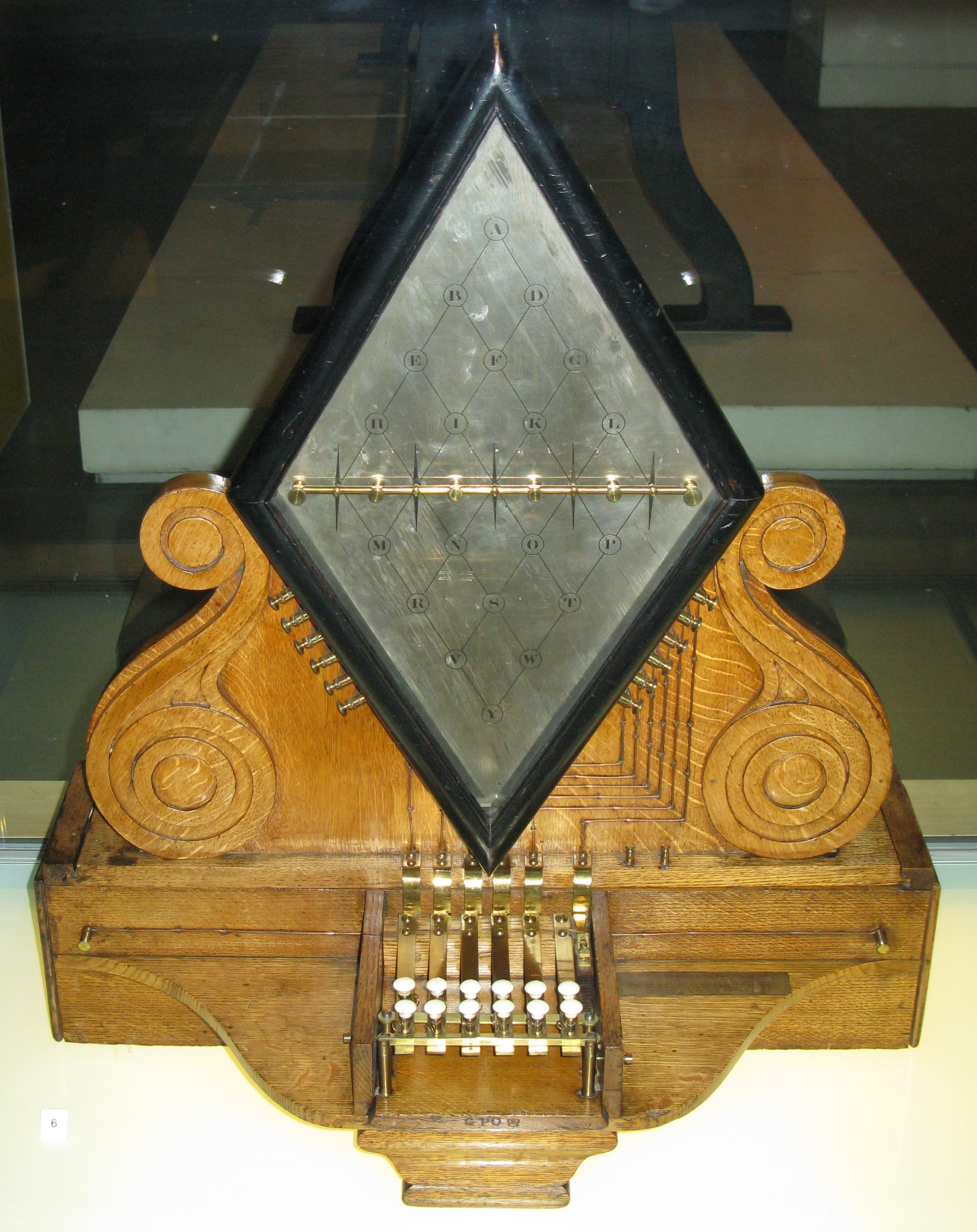
Cooke, Wheatstone and the 1837 patent
Several inventors in Europe built working electrical telegraphs in the 1830s. Pavel Schilling demonstrated a needle telegraph in St Petersburg in 1832. In 1833 Carl Friedrich Gauss and Wilhelm Weber ran a wire across the rooftops of Göttingen to connect the observatory and the physics laboratory. In Munich in 1836 Carl August von Steinheil built an instrument that recorded signals as marks.
William Fothergill Cooke, a young Englishman studying anatomy in Germany, saw a lecture at Heidelberg in March 1836 in which Georg Wilhelm Müncke demonstrated apparatus based on Schilling’s design. Cooke returned to London intending to build a telegraph for the railways. He lacked the electrical knowledge, and in 1837 he went into partnership with Charles Wheatstone, professor of experimental philosophy at King’s College London. Their joint patent was dated 10 June 1837.
How the five-needle instrument showed a letter
The instrument in the photograph above has five magnetic needles mounted in a row across a diamond-shaped dial. Each needle was connected to its own wire. Current sent in one direction through a coil behind a needle turned it to the left; current in the other direction turned it to the right. To signal a letter, the sender deflected two needles at once. Their pointers converged on one letter printed on the grid of the dial.
The receiver needed no code at all. Anyone who could read could watch the needles and write down the letters. The cost was in the wire and in the alphabet. The system needed five line wires, and the grid had room for only twenty letters. C, J, Q, U, X and Z were left out, so clerks spelled around them.
The Morse system went the other way. It needed only one wire, but the operator had to learn a code. Over the next twenty years British practice moved steadily in that direction.
Trials on the railways
Cooke’s customers were the railway companies, which were building long lines with single tracks and needed to know where their trains were. On 25 July 1837 Cooke and Wheatstone signalled between Euston and Camden Town on the London and Birmingham Railway, over a temporary circuit beside the line. The company did not adopt it.
The Great Western Railway did. A five-needle line between Paddington and West Drayton, about thirteen miles, was working by 9 April 1839. When the line was extended to Slough in 1843 it used a two-needle instrument, which needed fewer wires, and the telegraph at Slough was opened to the public for paid messages. The two-needle instrument no longer pointed at letters. Each letter was a combination of left and right movements of the two needles, and the clerks had to learn it.
Telegraphs also carried time. The Great Western adopted London time across its system in November 1840. In 1847 the Railway Clearing House recommended that all member companies keep Greenwich time, and from 1852 the Royal Observatory sent time signals by telegraph to London Bridge and onward over the lines of the Electric Telegraph Company, formed in 1846 to buy and exploit the Cooke and Wheatstone patents.
The Tawell arrest at Paddington, 1845
On 1 January 1845 Sarah Hart was poisoned at her home at Salt Hill, near Slough. A man in the distinctive dress of a Quaker had been seen leaving the house. He was John Tawell, and he went to Slough station and took a train for London.
The station staff sent his description ahead to Paddington by telegraph. The instrument had no Q, so the clerk spelled the word as KWAKER. When the train arrived, a railway police officer, Sergeant Williams, followed Tawell through London, and he was arrested soon afterward. He was tried at Aylesbury in March and hanged there on 28 March 1845.
The case was widely reported. It was the first time many people in Britain had heard of the telegraph being used to catch a suspect, and the episode did a good deal to persuade the public that the device had practical uses beyond railway business.
Single-needle instruments and operators who read by ear
From about 1845 Cooke and Wheatstone’s single-needle instrument became the standard British railway telegraph. It used one line wire. The sender worked a handle that sent current one way or the other, and the needle swung to the left or right. Each letter was a short sequence of left and right movements, which made it a two-element code very like Morse’s dots and dashes. Later practice treated left as a dot and right as a dash.
The needle struck small stops on either side of the dial, and the two stops were often made to give different sounds. Experienced clerks listened to the two notes and wrote without looking at the needle, much as American operators read the clicks of a sounder. Single-needle instruments stayed in use on some British railway circuits into the second half of the twentieth century.
Other systems on the Continent
France took a different route. Its state telegraph had run on the Chappe optical semaphore since the 1790s, and the first electric instrument, designed by Alphonse Foy and Louis Breguet and used on the Paris–Rouen line from 1845, reproduced the positions of the semaphore arms with two pointers so that existing operators could read it. France replaced it with Morse equipment in 1855.
In German-speaking countries the Morse recording telegraph spread quickly, but the American code caused trouble. Its internal spaces and dashes of different lengths were awkward to send and read consistently, especially when messages passed from one line or country to another. In 1848 Friedrich Clemens Gerke, an engineer on the Hamburg–Cuxhaven line, revised the code. He removed the internal spaces, used a single length of dash, and changed many of the letter codes. The German-Austrian Telegraph Union, founded in 1850 to coordinate traffic between member states, adopted Gerke’s code in 1851.
The Paris convention of 1865 and the shared code
By the 1860s a telegram crossing Europe could pass through several national administrations, each with its own tariffs, rules and equipment. A conference in Paris from 1 March to 17 May 1865 produced the International Telegraph Convention, signed by twenty states. It founded the International Telegraph Union, today the International Telecommunication Union, and its regulations adopted the Morse apparatus as the standard instrument for international lines. The code that went with it was based on Gerke’s revision of the American code and became known as Continental and later International Morse.
The two codes share some letters, such as E (a dot) and T (a dash), but many are different. International C is dash dot dash dot; in American Morse C is two dots, a space and a dot. International Morse has one dash length and none of the longer internal spaces of American Morse: every element of a character is followed by the same short gap. Its timing is now fixed by ITU-R Recommendation M.1677-1. A dash lasts three dots. The gap between elements of a letter lasts one dot, the gap between letters three, and the gap between words seven. Because every character is built from the same two elements and the same gaps, the code can be laid out as a binary tree of short and long signals, which is how the Omteish tree arranges it.