A company for ships
The Marconi International Marine Communication Company was formed on 25 April 1900 as a subsidiary of Marconi’s Wireless Telegraph Company. Its business was wireless for ships. It built coast stations and fitted ships with equipment, and it did not sell the sets. A shipping line paid a fee, and the Marconi company supplied the apparatus and the operators to work it.
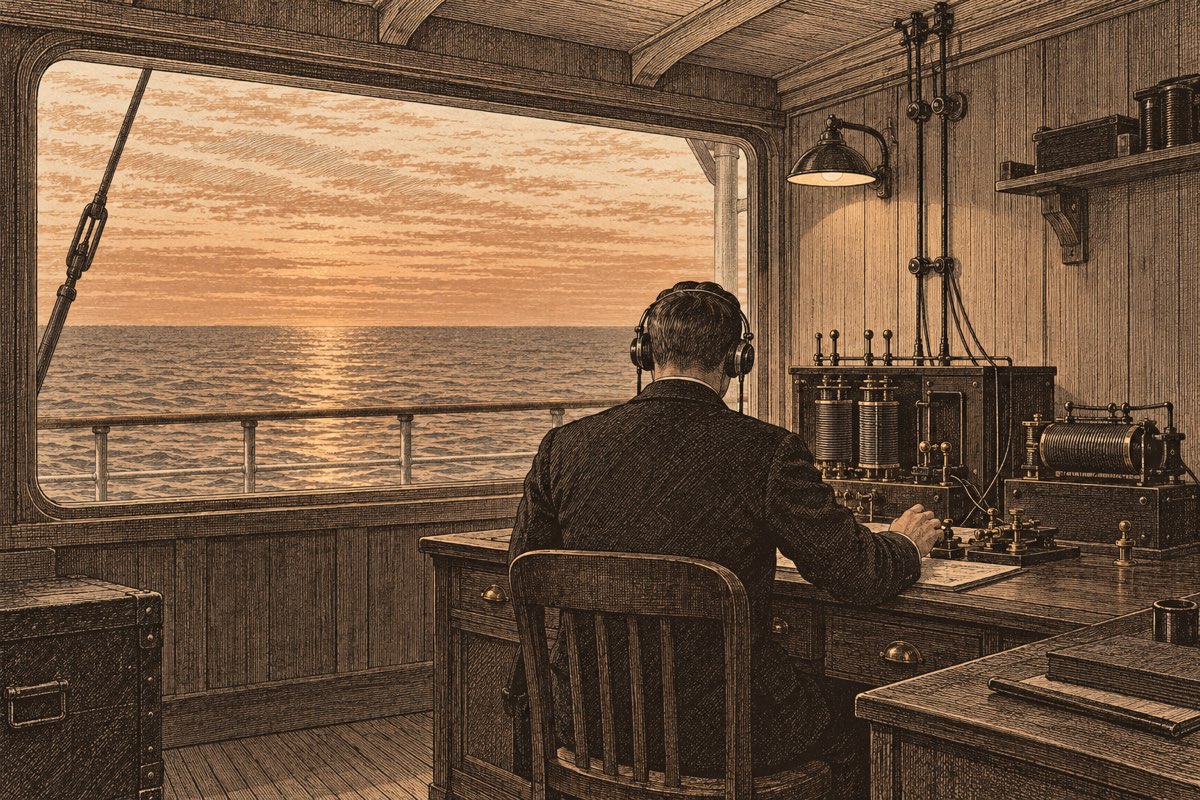
The arrangement meant that the man in the wireless room on most British liners, and on many others, was not an employee of the shipping line. He signed on the ship’s articles like any member of the crew and came under the master’s orders, but he was hired, trained, paid and posted by the Marconi company. At the United States Senate inquiry in April 1912, Harold Bride, the Titanic’s junior operator, was asked who employed him. He answered “The Marconi Co.’s, sir,” and said he was paid £4 a month and his board.
Pay, rank and work
A 1909 magazine article on wireless operators described them as young men, most under thirty, in “trim blue uniforms,” who ranked as officers and took their orders from no one but the captain. It also reported the pay: about twelve dollars a week for an experienced British operator such as Jack Binns, and a starting rate of sixty dollars a month on the American Line.
The company trained its own operators. Its first school opened at Frinton-on-Sea in Essex in 1901, and others followed, including one at Seaforth near Liverpool, where Jack Phillips trained in 1906. Students learned the equipment and practised Morse by ear until they could copy at a working speed through interference.
Most of an operator’s day was commercial. Passengers paid by the word to send private messages through the coast stations, and the revenue went to the Marconi company. Weather, ice reports, navigational warnings and distress calls had priority, but they arrived in between the paid traffic. The Titanic’s operators were clearing a backlog of passengers’ messages to Cape Race on the night of 14 April 1912.
Refusing the other system
The company protected its position with a rule that its stations would not exchange traffic with ships fitted by rival makers, except in an emergency. In March 1902 Prince Heinrich of Prussia, brother of the Kaiser, was returning to Germany aboard the Hamburg America liner Deutschland, which carried equipment of the German Slaby-Arco system. He tried to send a message of thanks to President Theodore Roosevelt through the station at Nantucket. The Marconi station refused it, and the Marconi station at the Lizard in Cornwall did the same at the other end of the voyage.
The German government protested and called a preliminary conference on wireless in Berlin in 1903. The question of compulsory intercommunication ran through the conferences that followed. The 1906 Berlin convention required coast stations to accept calls from ships regardless of the system they used, and the 1912 London convention, after the Titanic, confirmed it.
From company man to radio officer
Operators employed by the Marconi company and by similar firms in other countries remained a feature of merchant shipping for decades. Over time the job was formalised as that of radio officer, a certificated member of the ship’s officers, whether employed by the shipping line or by a radio company. The work stayed largely the same: keeping the watch on the distress frequency, handling traffic by Morse, and answering to the master. It came to an end at the close of the century, when automated distress systems removed the requirement to carry a Morse operator.