A ship without her captain
The Ward Line’s Morro Castle ran a weekly service between New York and Havana. On 5 September 1934 she left Havana for New York. On the evening of 7 September, with the ship off the coast of New Jersey, her master, Captain Robert Willmott, complained of stomach trouble and went to his cabin. He was later found dead. Command passed to the chief officer, William Warms.
At about 2:50 a.m. on 8 September a fire was found in a storage locker on B deck. It spread quickly through the ship’s public rooms, driven by a strong wind and the speed of the ship.
Waiting for an order
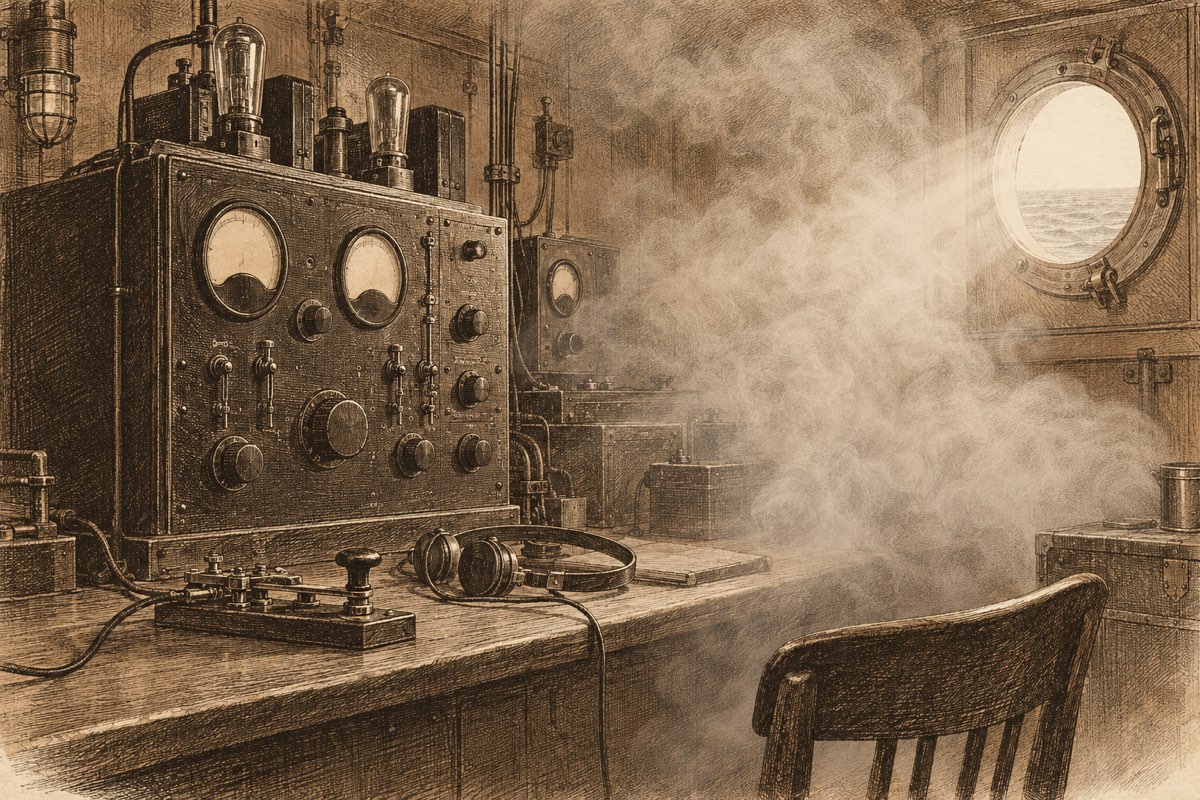
The chief radio operator was George White Rogers. His assistant, George Alagna, woke him and the two went to the radio room. The ship’s call letters were KGOV. A ship’s operator did not send a distress call on his own authority; he waited for an order from the master. With the bridge dealing with the fire, the order did not come. Alagna went to the bridge more than once to ask for it.
The SOS was ordered at 3:18 a.m. and went out at 3:23, about half an hour after the fire was found. By then the fire had reached the area around the radio room. Rogers later described the room filling with smoke, the emergency batteries bursting from the heat, and a loose power lead that he had to reconnect by feel. He kept sending until he could no longer stay in the room.
The beach at Asbury Park
Several ships and the Coast Guard came to the position, and boats and fishing craft picked people out of the water. Many lifeboats left with few passengers; many passengers jumped into the sea. Of the 549 people aboard, about 135 died; some accounts give 137. The burning hull was taken in tow, the towline parted, and the ship came ashore that evening off Asbury Park, New Jersey, where crowds came to look at her for months until she was towed away in March 1935.
Warms, the chief engineer Eban Abbott and a Ward Line vice-president, Henry Cabaud, were convicted on charges arising from the disaster. An appeals court later overturned the convictions of Warms and Abbott.
The operator’s later record
In the weeks after the fire Rogers was praised in the press as the man who stayed at his key in a burning room. His later history changed how people read his account. He joined the police radio service in Bayonne, New Jersey, and was convicted of trying to kill a colleague there, Vincent Doyle, with an incendiary device. After his release he was convicted of murdering an elderly neighbour and his daughter for money, and he died in prison.
Doyle spent much of his life arguing that Rogers had set the Morro Castle fire. No court tested that claim, and it has never been proved. What the record shows is narrower. The ship carried radio and two trained operators, and the delay of about half an hour between the discovery of the fire and the SOS came from the chain of command, not from the radio room.