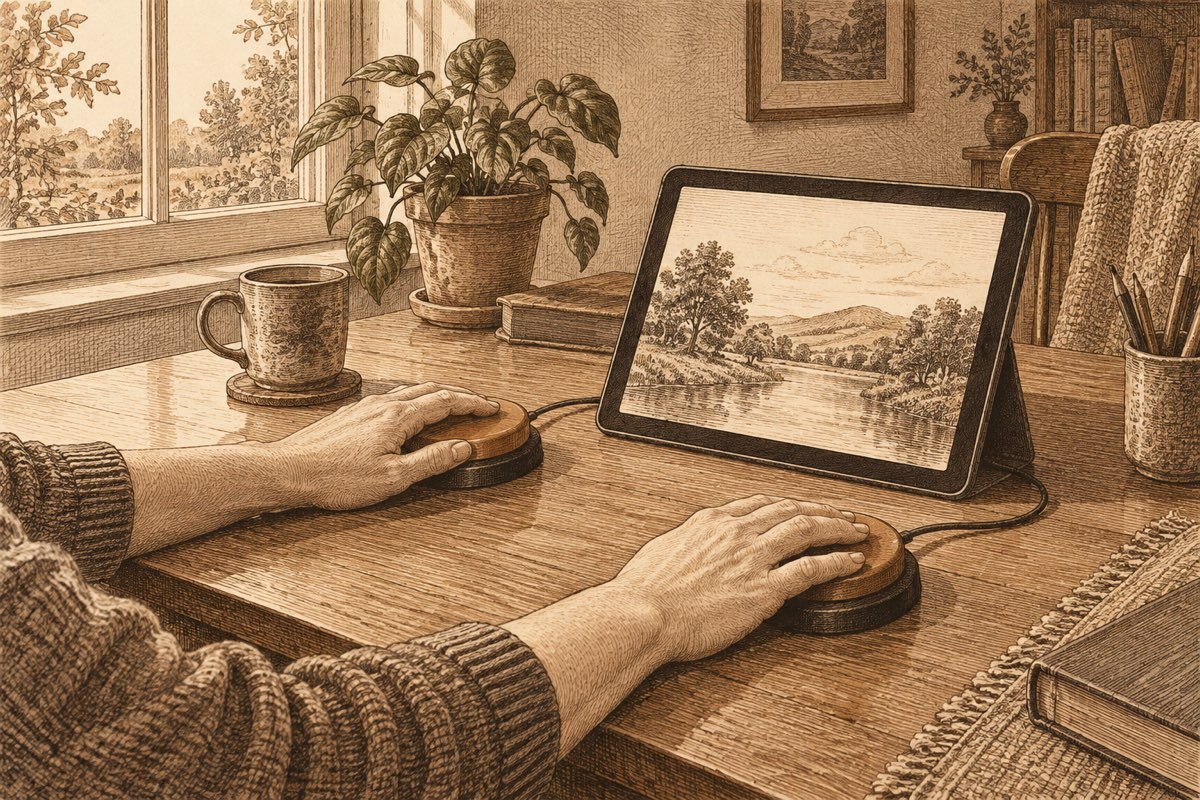
Switch input
Morse needs only two distinguishable signals, or even one signal held for two different lengths of time. That makes it usable by people who can make only a few controlled movements. A switch can be pressed by the head, a cheek, a foot or a finger, or operated by breath through a sip-and-puff tube, and a device or program can turn the dots and dashes into letters. Unlike scanning systems, in which a cursor moves across a grid of letters and the user waits to select one, Morse lets a practised user type at a steady rate without waiting.
From the 1980s onward several programs and hardware adapters let people type into personal computers in Morse, emulating a keyboard and mouse. Developers and clinicians in the field met at conferences such as the annual CSUN conference on technology and disability, and in 1999 a draft specification described how Morse input should work in Microsoft Windows.
Tania Finlayson
Tania Finlayson was born with cerebral palsy and cannot speak or use her hands to write. As a young child she communicated by answering yes-or-no questions, then by pointing to words on a board of about 200 words, and later by typing on a typewriter with a stick attached to her head. Before she reached middle school she joined a University of Washington study of children with cerebral palsy. The project’s research engineer, Al Ross, had built a keyboard-less computer that translated Morse into text. Finlayson later wrote that his device converted her Morse into letters, spoke them aloud in English and printed them on a small built-in printer.
She has used Morse to communicate ever since, with two switches mounted in cushions beside her head on her wheelchair. Tapping one side sends a dot and the other a dash. With her husband, Ken Finlayson, she designed the TandemMaster, a device that converts her Morse into keystrokes and mouse movements for a computer and into synthesised speech.
Morse on Gboard
In late 2017 Finlayson began working with the team behind Gboard, Google’s keyboard app for phones. At its I/O developer conference on 8 May 2018 Google showed a video of her and announced a Morse code input for Gboard, released the same day as a beta for Android. The keyboard replaces the letter keys with two large areas, one for dots and one for dashes, and shows suggested words above them as on the standard keyboard.
In July 2018 Google released Morse input for Gboard on iOS along with improvements on Android. In a post on Google’s blog, Finlayson wrote that she had helped design the keyboard layout, added Morse sequences to the suggestion strip above the keyboard, and developed settings that let people customise the keyboard to their needs. She and Ken also wrote open-source code for connecting external switches to Gboard on Android.
Learning the code
To help people learn the code, Google released a game alongside the keyboard, available on Android, iOS and desktop browsers, and said it could teach the Morse alphabet in under an hour. Google also published a poster of the code for new users.
Finlayson wrote that most technology is designed for the mass market and that people with disabilities can be left behind as a result. With Morse input built into a standard keyboard app, a person who uses switches can type on an ordinary phone.