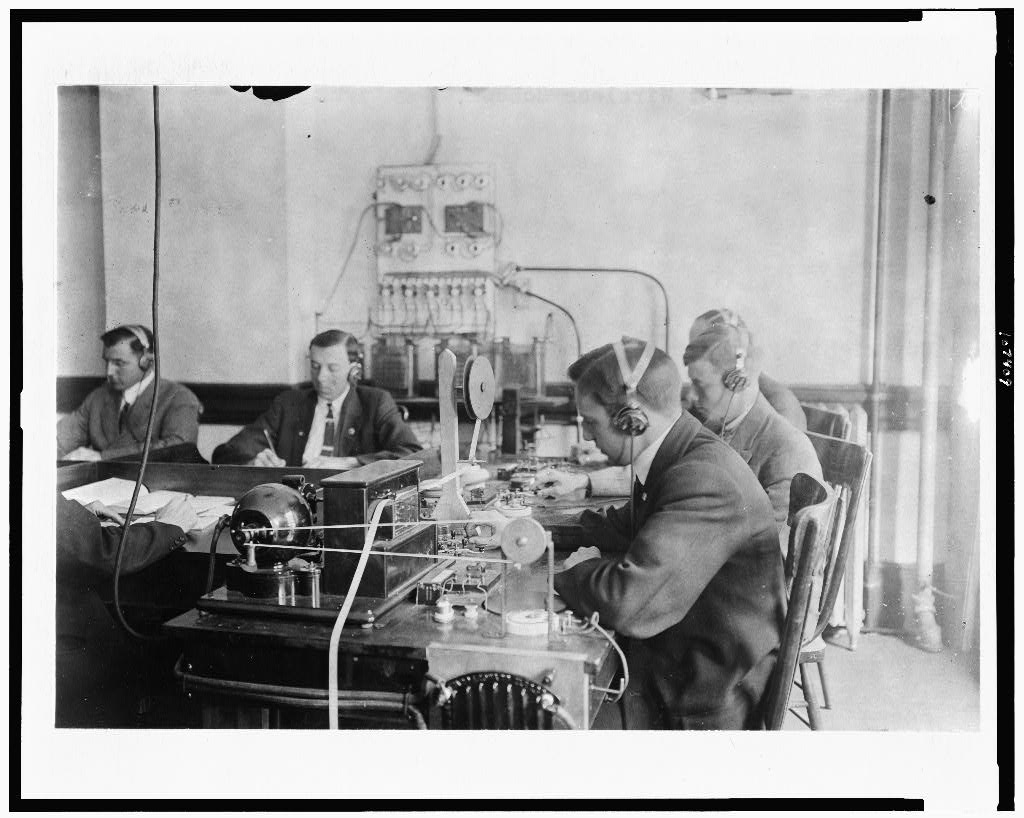
Training operators at the Marconi school
The photograph above, taken by Underwood & Underwood around 1912, shows students practising at the Marconi wireless school in New York. They sit at a long bench, each with a key and a receiver, sending to one another. Other photographs from the same school show classes in the technical side of the equipment and operators copying messages from ships at sea.
A shipboard operator in this period usually worked for the wireless company, not the shipping line. On British and many American ships the Marconi company employed him, leased the equipment to the line and earned its revenue from passengers’ private messages. Weather reports, navigational warnings and distress calls took priority, but most of an operator’s day was commercial traffic.
The core skill was copying Morse by ear at speed, often through static and the signals of other stations. Sending and receiving were trained separately. A sender had to keep even timing on the key so that a distant listener could separate letters and words. A receiver had to recognize characters by their sound as whole patterns, not count dots and dashes, and write them down as they arrived. United States regulations issued in September 1912 required a first-grade commercial operator to send and receive Continental Morse by ear at no less than twenty words a minute.
CQ and CQD
CQ was already in use on British land telegraph lines as a general call, meaning a message for all stations. The Marconi company adopted it for wireless. In a circular dated 7 January 1904, effective 1 February, it instructed its operators to use CQD as the call for a ship in distress: the general call followed by D. The letters were not an abbreviation of a phrase, although “come quick, danger” was later attached to them.
CQD had two weaknesses. It was a company signal, and ships using other makers’ equipment had no obligation to recognize it. It also sounded much like ordinary traffic. CQ was heard all day, and a listener had to catch the D to know the call was urgent.
The German signal and the Berlin conferences
Wireless was new enough that there were no international rules for it. A preliminary conference in Berlin in August 1903, attended by nine countries, agreed some general principles. Germany then issued its own regulations, in force from 1 April 1905, which included a distress signal of three dots, three dashes and three dots, sent as one group.
The International Radiotelegraph Conference met in Berlin in 1906. The convention was signed on 3 November 1906 and came into force on 1 July 1908. Its service regulations adopted the German pattern as the international distress signal, to be repeated at short intervals by a ship in distress. Coast stations were required to accept calls from ships regardless of the make of their equipment, a provision aimed at the Marconi company’s practice of refusing traffic from rival systems. Britain and Italy, where Marconi interests were strongest, entered reservations on that point.
The agreement and its effective date are separate events. SOS was agreed in 1906 and became the official signal under the convention in 1908. Marconi operators continued to use CQD for some years after that.
Why SOS is one signal and not three letters
In International Morse, S is three dots and O is three dashes. Sent as ordinary letters, S O S would have a three-unit gap after each letter. The distress signal has no such gaps. All nine elements run together with only the one-unit spacing used inside a character: ···−−−···. It is a procedural signal, or prosign, and in print it is often written with a bar over the letters to show they are joined.
The letters S, O and S are only a convenient way to name and remember the rhythm. The signal was chosen because the pattern is simple, symmetrical and hard to mistake for anything else, even by an operator who has heard only part of it. It does not stand for “save our souls” or “save our ship”; those phrases were invented afterward.
Sent as a distress signal, SOS has no gaps between its letters. The same three letters sent as a word, with normal letter spacing, are not the distress signal.
Titanic’s wireless room, April 1912
Titanic struck an iceberg at 11:40 p.m. ship’s time on 14 April 1912. Her two Marconi operators were Jack Phillips and Harold Bride. Phillips began sending CQD with the ship’s position. Bride suggested he also try SOS, the new international signal, and from then on they sent both.
The ship that reached her was the Cunard liner Carpathia, whose single operator, Harold Cottam, picked up the call and took it to the bridge. Carpathia turned toward the position and arrived at about 4 a.m., after Titanic had sunk, and took about 705 survivors from the lifeboats. Phillips was among those who died.
Another ship, the Californian, was much closer. Her only operator, Cyril Evans, had warned Titanic of ice earlier that night, then shut down his set and gone to bed at about 11:30 p.m. Nobody aboard heard the distress calls. The British and American inquiries both examined the point closely.
Rules written after the sinking
The United States acted within months. An amendment of 23 July 1912 to the Wireless Ship Act of 1910 required large passenger ships to carry two operators, keep a continuous radio watch and have an auxiliary power supply for the transmitter. The Radio Act of 13 August 1912 required operators and stations to be licensed.
The International Radiotelegraph Convention signed in London on 5 July 1912, in force from 1 July 1913, kept SOS as the distress signal and added rules on watches, including set listening periods for ships that did not keep a continuous watch. The first International Convention for the Safety of Life at Sea, signed in London on 20 January 1914, would have required continuous radio watch on many ships, but the First World War prevented it from entering into force. In 1927 the Washington radiotelegraph conference adopted Mayday as the spoken distress call for radiotelephone, alongside SOS in Morse.
The end of the Morse distress watch
For most of the twentieth century ships and coast stations kept a watch on 500 kHz, the international Morse distress and calling frequency. That system was replaced by the Global Maritime Distress and Safety System, adopted through amendments to the Safety of Life at Sea convention in 1988. GMDSS relies on satellite communications, digital selective calling and automatic emergency beacons, and it does not depend on a trained operator hearing a signal. It was phased in from 1 February 1992 and became fully mandatory on 1 February 1999, when the requirement for ships to keep a Morse watch ended.
Some services stopped earlier. The United States Coast Guard closed its Morse watch on the high-frequency bands at the end of March 1995. Morse is still used by radio amateurs and taught for its own sake, and SOS remains the best-known pattern in the code, but it is no longer what the shipping rules rely on.