One-way radio to agents
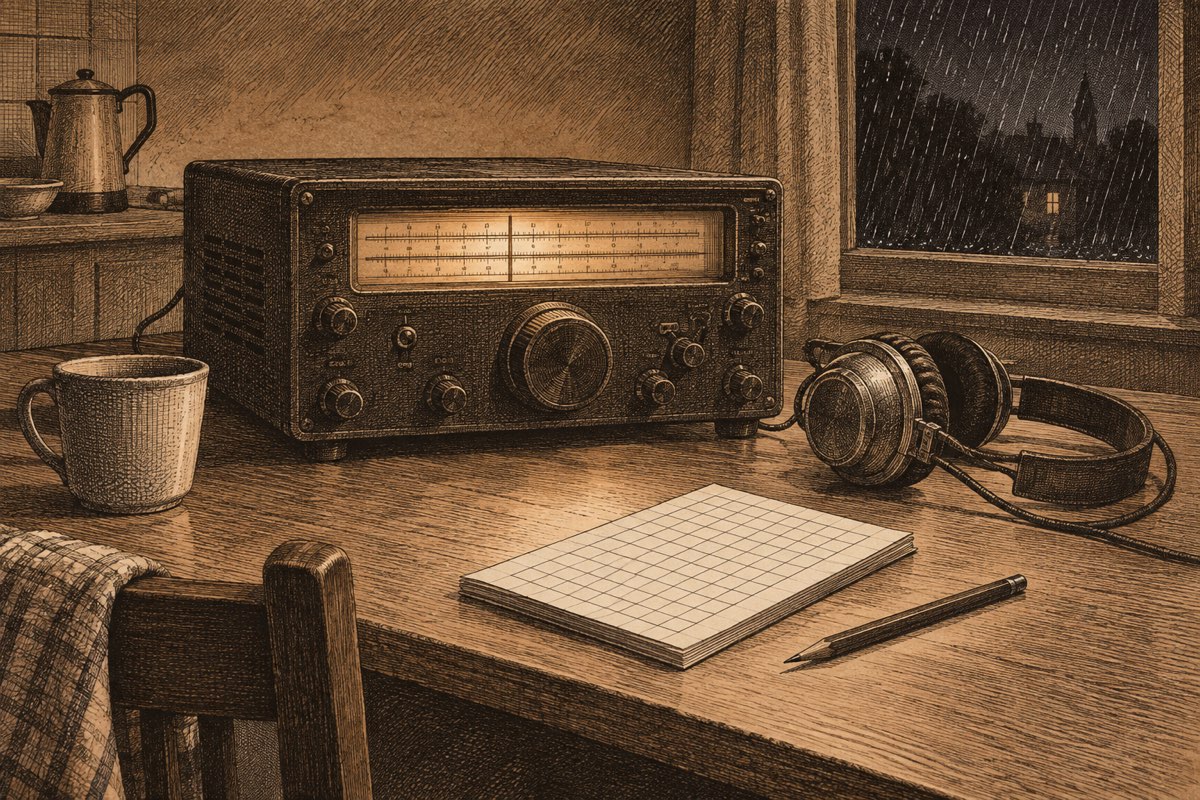
An agent working in a foreign country needs instructions from home, but carrying a transmitter or meeting a handler is risky. A broadcast avoids both. If the message is sent on shortwave radio, it can be heard by anyone over a very large area, and receiving it leaves no trace. The agent needs only an ordinary shortwave receiver, which in the Cold War was a common household object in many countries, and the key to decipher what was sent.
Throughout the Cold War, listeners around the world heard broadcasts of this kind: stations that transmitted nothing but groups of numbers, or sometimes letters, at regular times on shortwave frequencies. Hobbyists called them numbers stations. Some used a recorded or synthesised voice reading numbers in a language such as German, Spanish, Russian or English. Others sent the groups in Morse code.
The one-time pad
The messages were generally enciphered with one-time pads. Each pad is a sheet of random digits used once and then destroyed. The sender adds the pad’s digits to the coded message and the receiver, holding the matching sheet, subtracts them. If the digits are truly random, never reused and kept secret, the result cannot be broken by cryptanalysis, which is why a station could broadcast openly to anyone listening.
The weak point was the agent. A pad found during a search, or a shortwave radio and notes found together, could be evidence of espionage, and in several prosecutions it was.
Numbers in Morse
Morse was suited to the job. It travels well on shortwave, where a single tone can be copied by ear through noise and fading that would make speech hard to understand. Morse digits are all five elements long, from one dot and four dashes for 1 to five dashes for 0, which makes number groups slow to send. Some stations sent abbreviated or “cut” numbers, in which common digits were replaced by shorter letters, such as T, a single dash, for 0 and N, dash dot, for 9, a practice also used by radio amateurs.
Radio enthusiasts in Europe and North America logged these stations for decades, recording schedules, formats and call-up patterns. In the 1990s a group called the European Numbers Information Gathering and Monitoring Association, known as ENIGMA, catalogued them with letter prefixes by type, such as E for English-language voice stations and M for Morse stations. Its successors still use the system. The station hobbyists call M12, for example, sends groups of numbers in Morse and is attributed by listeners to Russian intelligence, alongside voice stations of the same family. The governments operating these stations did not, as a rule, acknowledge them, and attributions rest on listeners’ analysis rather than official statements.
Evidence in court
Prosecutions have confirmed how such broadcasts were used, though the best-documented cases involve voice stations rather than Morse. Ana Belén Montes, a senior analyst at the US Defense Intelligence Agency who spied for Cuba, received her instructions by listening on a shortwave receiver to a Cuban station on which a woman’s voice read groups of numbers in Spanish. She deciphered them on a laptop computer. The FBI recovered material from the laptop and found the shortwave radio when it searched her home. She was arrested in 2001, pleaded guilty in 2002 and was sentenced to twenty-five years in prison.
Whether the numbers arrive as speech or as Morse, the method is the same: a one-way broadcast that anyone can hear and only the holder of the right pad can read. Many numbers stations went silent after the end of the Cold War in 1991. Some kept broadcasting, including Morse stations, and listeners continue to log them on shortwave.