A mail service on horseback
On 3 April 1860 the first riders of the Pony Express set out from St. Joseph, Missouri, and Sacramento, California, at opposite ends of a route of about 2,000 miles. The service was run by the freighting firm of Russell, Majors and Waddell. Riders carried letters in relays, changing horses at a chain of stations across the plains, the Rocky Mountains and the Great Basin, and a letter could cross the distance in about ten days. The firm needed some 400 horses, about 80 riders at a time and more than 180 relay stations, most of them set up in the few weeks before the first run.
Ten days was fast for 1860. Before the Pony Express, mail to California went by stagecoach or by sea and could take weeks. The faster service was expensive to run, however, and it carried only letters, charged at a high rate. Within weeks of its first run, Congress agreed to pay for a telegraph line along much the same corridor.
The Pacific Telegraph Act
On 16 June 1860 President James Buchanan signed the Pacific Telegraph Act. It offered a subsidy of $40,000 a year for ten years to the company that built a working telegraph line from the western border of Missouri to San Francisco, and it required the line to carry government messages. Hiram Sibley of the Western Union Telegraph Company secured the contract after rival bidders withdrew.
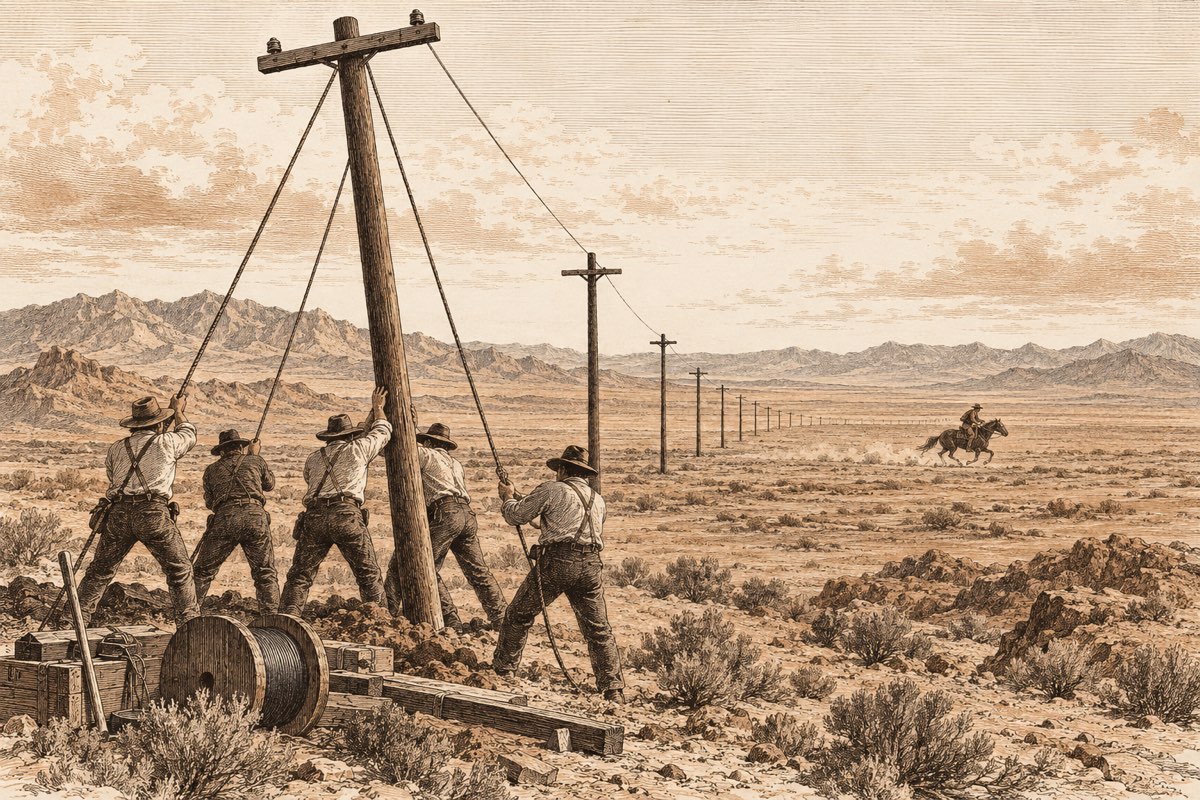
The work was divided between two companies. The Pacific Telegraph Company, with Edward Creighton in charge of construction, built west from Omaha, Nebraska, toward Salt Lake City. The Overland Telegraph Company, with James Gamble in charge, built east from Carson City in what is now Nevada, through Ruby Valley, Egan Canyon and Deep Creek, largely over the route the Pony Express riders were using. Crews set roughly 27,500 poles and strung about 2,000 miles of single iron wire.
Messages through Salt Lake City
The eastern line reached Salt Lake City first, on 17 October 1861, and messages were sent from the city the next day. Brigham Young, the leader of the Church of Jesus Christ of Latter-day Saints, telegraphed Jeptha Wade, the president of Western Union, to congratulate him. Frank Fuller, the acting governor of Utah Territory, wired President Abraham Lincoln to affirm the territory’s loyalty to the Union, which was a pointed message six months into the Civil War.
On 24 October 1861 the western line was joined at Salt Lake City and the circuit ran from coast to coast. That evening Stephen J. Field, the chief justice of California, sent a message to Lincoln stating California’s loyalty to the Union and its hopes for the new line. In the first week the line charged one dollar a word, a high price that limited ordinary use to people and businesses with urgent reasons to pay it.
The last run
The Pony Express was announced as closing on 26 October 1861, two days after the telegraph circuit was completed. It had operated for about eighteen months. It lost money for Russell, Majors and Waddell. The telegraph did not replace the mail; letters and packages still needed carrying, and the transcontinental railroad that took over most of that work was not finished until 1869. What the telegraph took away was the one service the Pony Express existed to sell, which was speed for short written news.
Messages on the new line were keyed by hand in American Morse, the version of the code used on North American landlines, and read by ear from sounders in the telegraph offices along the route.