The order sent from Turner’s
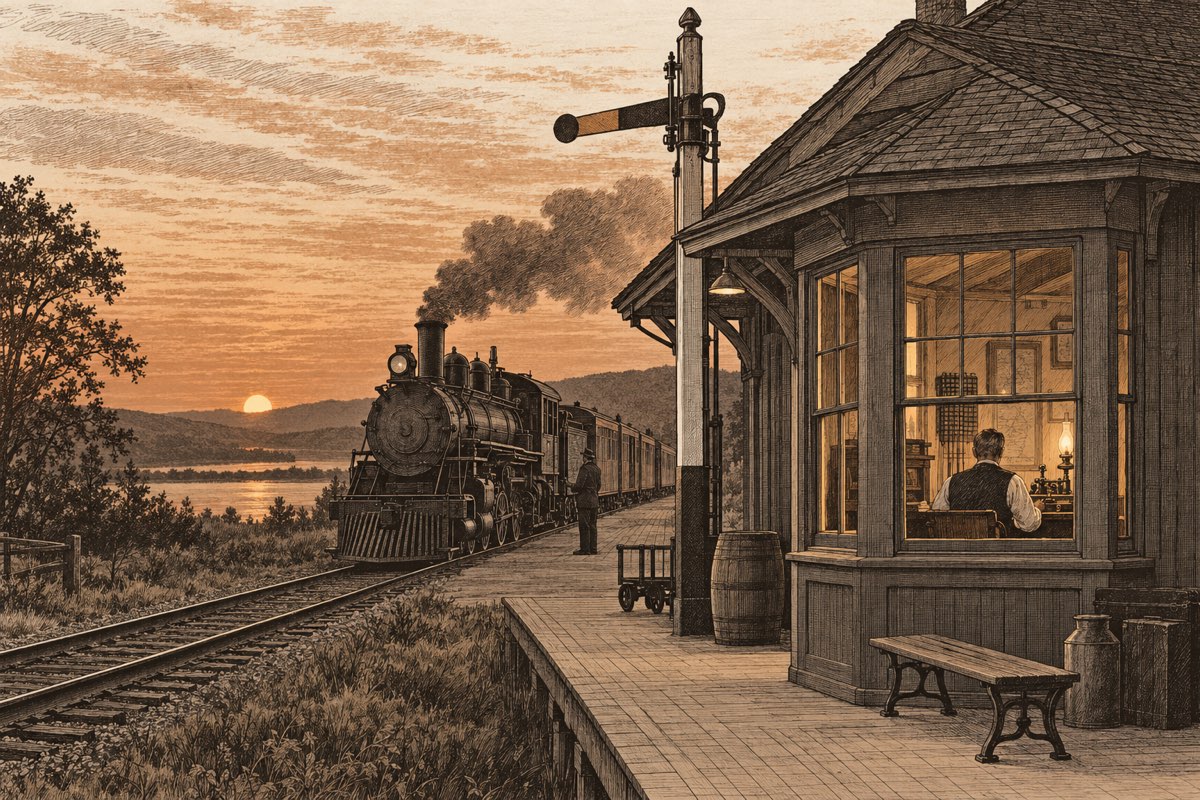
Most early American railways had a single track, with sidings where trains could pass. Trains ran to a printed timetable, and when one was late the rules required an opposing train to wait for it, sometimes for hours. On 22 September 1851 Charles Minot, general superintendent of the New York and Erie Railroad, was aboard a westbound train held at Turner’s, New York, waiting for an eastbound train that had not arrived. He telegraphed the station at Goshen, 14 miles ahead, with an order telling the operator there to hold the eastbound train, and gave his own crew a written order to run to Goshen regardless of the opposing train.
The order worked, and the Erie began dispatching trains by telegraph. Other railways followed. Over the next decades the telegraph office became a standard part of the railway station, and the station agent or operator became the person who passed instructions between the dispatcher and the trains.
How a train order was handled
A train dispatcher, working at a division office with a train sheet showing every train on the line, wrote out orders that changed the timetable: where two trains would meet, which would wait on a siding, or how late a train was running. The dispatcher sent each order by Morse to the operators at the stations concerned. Each operator copied it by hand on a printed form and then repeated it back to the dispatcher, who checked it against the original before marking it complete. The repetition was the safety check. A wrong digit in a time or a misread station name could put two trains on the same track.
Railways adopted standard forms. A Form 31 order required the train to stop so that the conductor and engineer could each sign for it. A Form 19 order did not require a signature and could be handed up to a moving train. Operators clipped the paper to a hoop on a long handle and held it up beside the track; a crew member caught it with an arm through the hoop and dropped the hoop back on the ground. Operators also reported each train as it passed their station. The dispatcher entered these “OS” reports on the train sheet and used them to plan the next meets.
American Morse on a sounder
Railway operators worked in American Morse, the version of the code used on North American landlines, which had dashes of different lengths and spaces inside some letters. Most offices received by ear from a sounder, an electromagnet and lever that clicked on each change in the current, rather than from paper tape. An operator might listen to a single wire shared by many stations and respond only to his or her own station’s call letters, while ignoring the rest of the traffic.
The work required speed and accuracy over long shifts. At many small stations the agent who sold tickets and handled freight was also the telegraph operator.
The Order of Railroad Telegraphers
On 9 June 1886 railway operators meeting in Cedar Rapids, Iowa, founded the Order of Railway Telegraphers of North America, organised by Ambrose D. Thurston, the publisher of a trade journal for operators. At first it was mainly a fraternal society and its constitution discouraged strikes. It had 2,250 members by March 1887 and 9,000 by March 1889. In 1891 it reorganised as a trade union under the name Order of Railroad Telegraphers. By 1922 it had about 78,000 members in the United States, Canada and Mexico.
The telegraph train order declined slowly. Many railways moved to dispatching by telephone in the early twentieth century. In 1927 the General Railway Signal Company installed the first Centralized Traffic Control on 40 miles of New York Central track between Berwick and Stanley, Ohio, allowing a dispatcher to set switches and signals remotely without written orders. Lines converted one at a time over several decades, and American Morse could still be heard on some railway circuits into the 1960s.