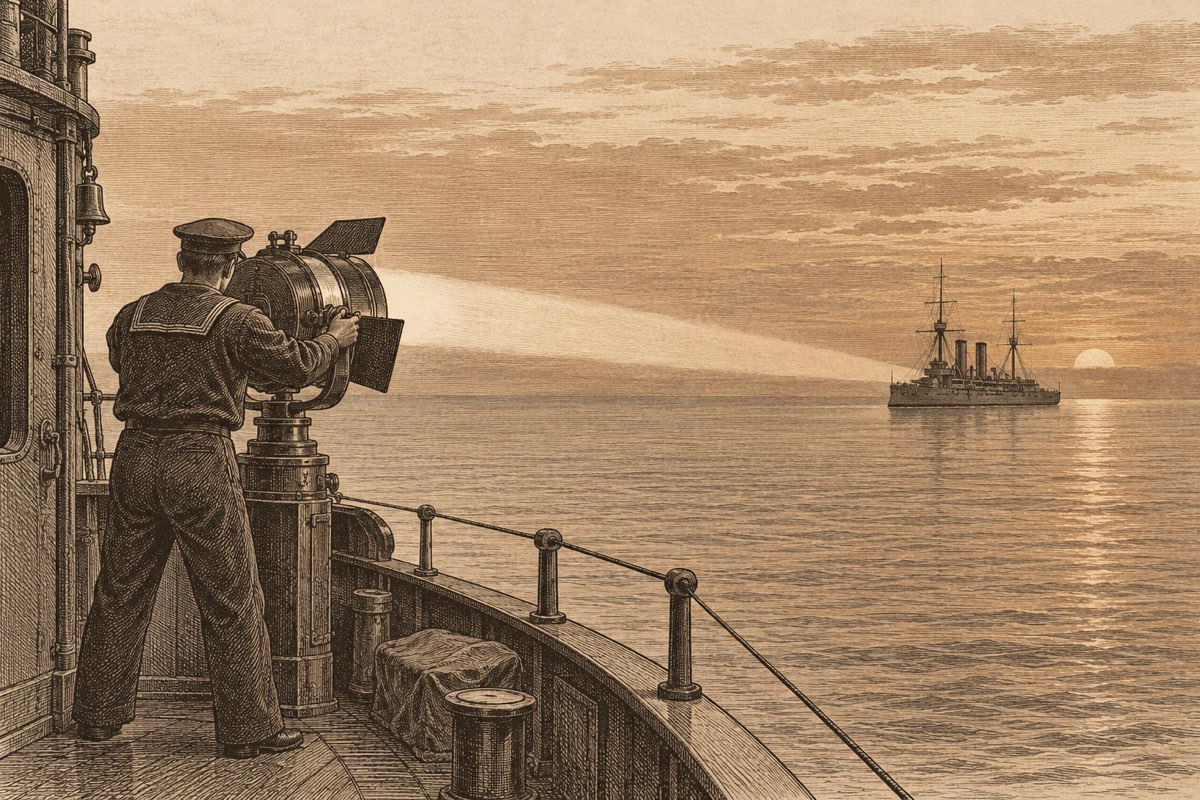
Flashing signals at night
Before wireless, ships signalled to each other by flags in daylight and had few good means at night. In the 1860s Captain Philip Colomb of the Royal Navy, working with Francis Bolton of the army, developed a system of flashing signals using short and long flashes of light. The Royal Navy adopted it in 1867. Colomb’s code was not the same as Morse code, but the principle was the one that lasted: a message spelled out in short and long flashes, read by eye.
Over the following decades the navies and the merchant service settled on Morse code for light signalling, the same alphabet used by wireless operators, so that the same men could read both.
The Aldis lamp
The best-known signalling lamp was designed by Arthur Cyril Webb Aldis, a Birmingham optical manufacturer. He developed a portable daylight signalling lamp in 1915, at first for signalling between aircraft and the ground, and patented it in 1916. The Royal Flying Corps was using it by the Battle of the Somme that summer.
An Aldis lamp did not switch its light on and off. The lamp burned steadily, and a trigger tilted a mirror or worked a set of shutters, so that the beam was thrown toward the receiver for the length of a dot or a dash and away from him in the gaps. Because the beam was narrow and concentrated, it could be read at a distance in daylight, and it could be aimed so that only the intended ship saw it. The name “Aldis lamp” came to be used for hand-held signalling lamps in general.
The procedure
Signalling by light follows the same timing as Morse by sound. The International Code of Signals defines a dot as one unit, a dash as three units, the space between the parts of a letter as one unit, between letters three units and between words seven units. Its procedure for flashing light is set out step by step. A ship calls an unknown station with AA AA AA, or a known one by its identity signal. The other ship answers with a string of Ts. The sender then transmits the message word by word, and the receiver flashes a single T after each word to show it was read. The end of a message is AR, answered by R.
Light is slower than radio. The receiver reads with his eyes, often through binoculars, while someone else writes down the letters, and the sender works a shutter by hand. Messages by lamp were kept short.
When radio had to be silent
In the Second World War signal lamps became essential in Atlantic convoys. German direction-finding stations and U-boats could locate a ship from her radio transmissions, so merchant ships in convoy and their escorts kept radio silence. Orders for changes of course, station-keeping and the movements of the escort group passed by flag in daylight and by lamp, carefully shaded, when visibility allowed. A beam aimed at the next ship in the column was very difficult for an enemy to see.
Signal lamps did not disappear with the end of Morse radio watch. The International Code of Signals, maintained by the International Maritime Organization, still sets out the flashing-light procedure, and the Safety of Life at Sea convention still requires most seagoing ships to carry a daylight signalling lamp. It is one of the few places in professional shipping where Morse code is still part of the equipment.