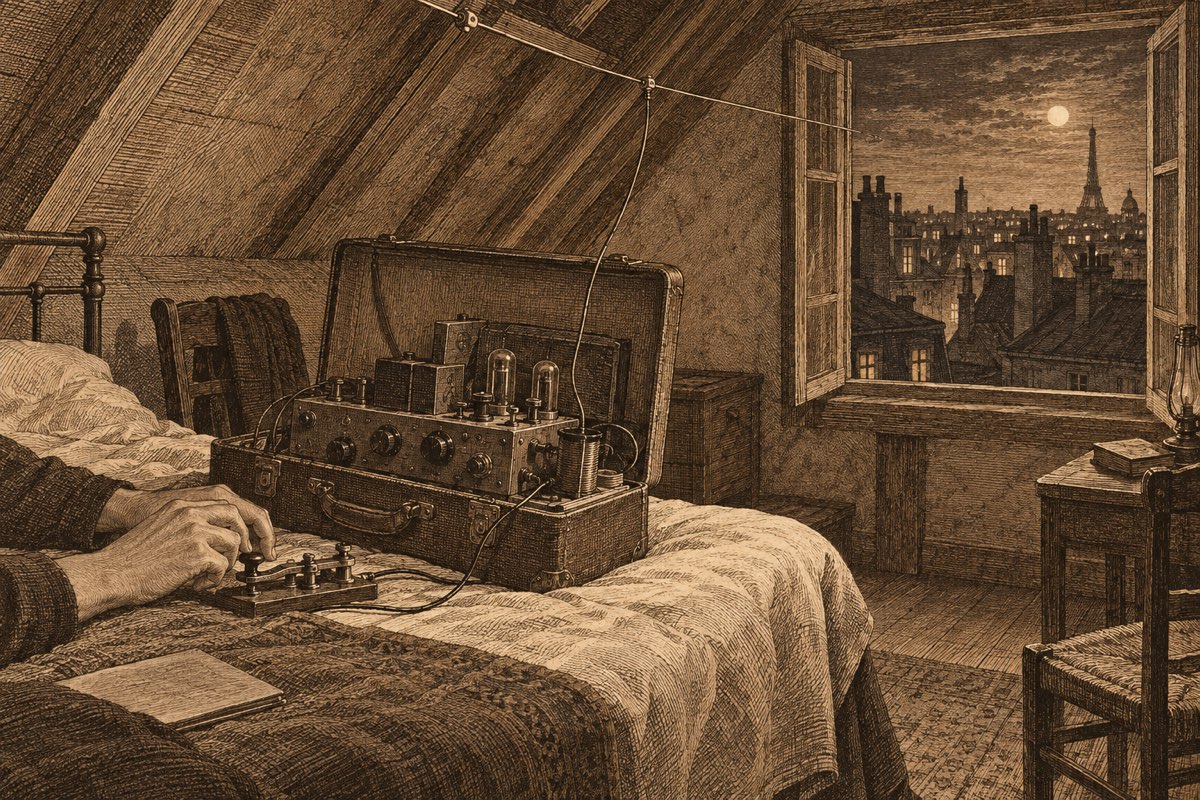
The most exposed job
The Special Operations Executive, formed in Britain in 1940, sent agents into occupied Europe to organise sabotage and support resistance groups. Every network needed a link to London, and that link was a wireless operator with a portable transmitter packed in a suitcase. The sets included the Type A Mk III, weighing about 13 pounds, and the heavier Type 3 Mk II, known as the B2, at about 33 pounds, both designed by SOE’s own engineers. The operator sent and received Morse on prearranged frequencies at scheduled times, to and from receiving stations in England.
German radio security units used direction-finding equipment to locate clandestine transmitters, first narrowing an area by long-range bearings and then closing in with detector vans and portable sets. The longer an operator stayed on the air, and the more often they used the same place, the more likely they were to be found. Wireless operators were among the most frequently captured of all SOE agents.
Noor Inayat Khan
Noor Inayat Khan was born in Moscow on 1 January 1914, the daughter of Inayat Khan, an Indian musician and Sufi teacher, and his American wife. She grew up mainly in France, near Paris, and wrote and published children’s stories. The family left France for Britain in 1940. On 19 November 1940 she joined the Women’s Auxiliary Air Force, and she became one of the first WAAF members trained as a wireless operator, which brought her to the attention of SOE’s French Section.
SOE trained her as a clandestine operator. On the night of 16–17 June 1943 she was landed in France by a Lysander aircraft to work as a wireless operator for the Prosper network in Paris, under the code name Madeleine. She was the first woman SOE sent into occupied France as a wireless operator.
Alone in Paris
Within days of her arrival, the Germans began arresting members of the Prosper network, and the network collapsed over the summer. Noor Inayat Khan avoided arrest. She stayed in the Paris area, moving between addresses and continuing to transmit to London for about three and a half months, at a time when few other SOE operators there were still on the air.
She was betrayed and arrested by the Germans in Paris in mid-October 1943. She attempted to escape and was then classed as dangerous and uncooperative.
Pforzheim and Dachau
In November 1943 she was sent to prison in Pforzheim, in Germany, where she was kept in solitary confinement and in chains for about ten months. In September 1944 she was moved to Dachau concentration camp with three other SOE women, Yolande Beekman, Madeleine Damerment and Eliane Plewman. All four were shot there in September 1944; sources differ on whether it was the 12th or 13th. The Commonwealth War Graves Commission records that her last word was “Liberté”.
She was posthumously awarded the George Cross in 1949, and France awarded her the Croix de Guerre. In 2020 an English Heritage blue plaque was unveiled at 4 Taviton Street in Bloomsbury, London, where she had lived with her family, the first such plaque to commemorate a woman of Indian descent.