From messenger boy to operator
Theodore Roosevelt McElroy was born in 1901. He began work as a Western Union messenger boy at fourteen and learned telegraphy there, moving on to work as an operator. He later held the amateur radio call sign W1JYN. By the 1920s and 1930s he was taking part in code-speed contests, which were a regular feature of radio conventions and amateur meetings.
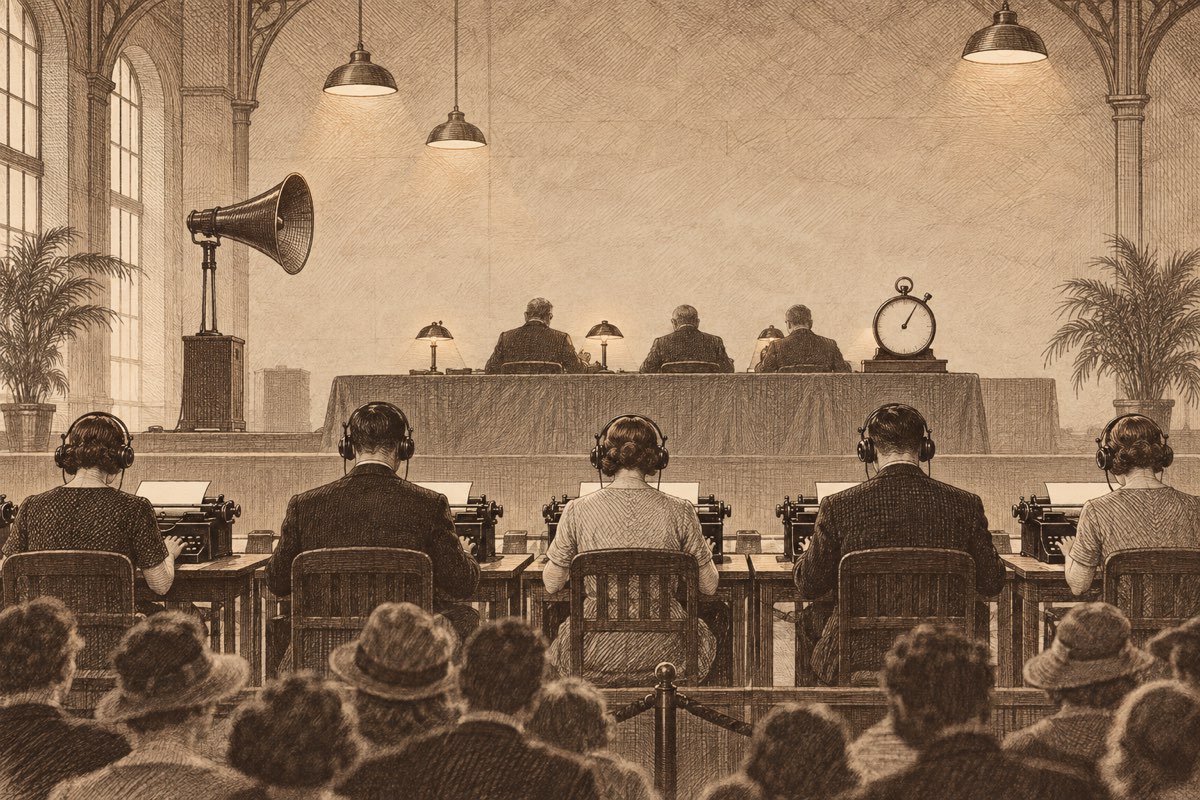
Receiving contests tested how fast an operator could copy plain-language text sent in Morse without errors. The operator sat at a typewriter, which operators called a “mill”, and typed each word as it came. Experienced receivers did not type each letter as they heard it. They held several words in memory and typed a few words behind the sender, which let them recognise whole words by sound and gave them time to correct the occasional doubtful letter from context.
World champion
McElroy won a series of contests in the 1930s and was billed as the world champion radiotelegrapher. In 1934 he founded McElroy Manufacturing to make telegraph keys, semi-automatic “bug” keys and related equipment. The keys were marked with his name and his title as champion, and they are now collected by amateurs.
Asheville, 2 July 1939
On 2 July 1939 the Asheville Amateur Radio Club held a hamfest at the George Vanderbilt Hotel in Asheville, North Carolina. The club’s president, John K. Whisnant, W4KI, had arranged a code-speed contest as the event’s main attraction. About 400 amateurs attended, and the evening before, McElroy and other contestants were interviewed on the local radio station WWNC.
In the contest McElroy copied Morse at 75.2 words per minute. L. R. McDonald was runner-up. Jean Hudson, a fourteen-year-old licensed operator from Delaware, won the junior class at 30 words per minute. The Asheville newspaper reported McElroy’s result as a new world record, and it is still widely cited as the fastest Morse receiving speed set in competition. The figure rests on contemporary reports rather than certification by any standards body.
After the hamfest McElroy sent Whisnant two of his own keys, a Mac Key and a Stream Key, in thanks for the invitation. Whisnant’s account of the day, with the newspaper report, is one of the main records of the contest.
What 75 words per minute means
Morse speed is measured by counting standard words. Under the convention now used for timing, based on the word PARIS, a word is fifty dot-lengths long, including the gaps. At 75 words per minute, a dot lasts about 16 milliseconds and a dash about 48. The letters arrive at roughly six a second. At that rate the individual dots and dashes run together and the listener hears each letter, and often each common word, as a single sound.
For comparison, the United States required 20 words per minute for its highest amateur licence class for most of the twentieth century. McElroy’s record at Asheville was set with a typewriter, at a contest open to the public, and not in a working office.
McElroy died in 1963. McElroy keys and the story of the Asheville contest have remained part of amateur radio culture.