Ten words and a rate per word
For most of their history, American telegrams were priced by the word, with a base charge covering the first ten words and a further charge for each word after that. Rates depended on distance. Correspondence in the files of the US State Department for 1874 lists Western Union’s rates from New York: 40 cents for ten words to Washington and 3 cents for each additional word; one dollar for ten words to Chicago and 7 cents for each additional word; and $2.50 for ten words to San Francisco and 17 cents for each additional word.
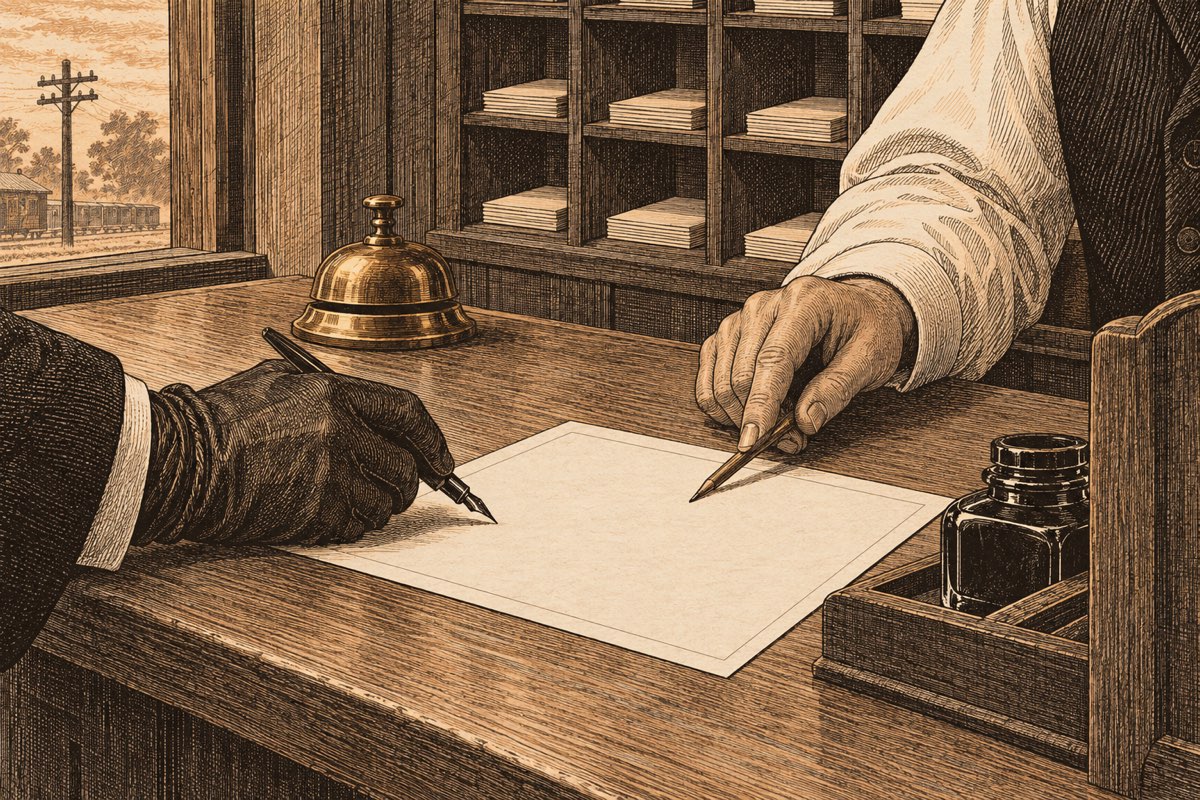
The charge was set by the length of the message because each word cost an operator time to key and receive. A message was counted at the counter, paid for, and then sent by an operator in Morse. At the receiving office another operator wrote or typed it out, and a messenger carried it to the addressee.
Writing for the tariff
Customers learned to write short. Articles, pronouns and polite phrases were dropped, and the clipped result became the familiar telegram style. International rules set by the conferences of the International Telegraph Union defined what counted as a word. A plain-language word of up to 15 letters counted as one word in European traffic, and up to 10 letters in traffic between continents, which stopped senders from running words together to save money.
Businesses went further and used commercial codebooks. The ABC Telegraphic Code and Bentley’s Complete Phrase Code, among many others, assigned single invented code words to whole phrases about prices, shipments and orders. Bentley’s code words were built so that any two differed by at least two letters, which reduced the chance that a single error in transmission would turn one valid code word into another.
Western Union also sold cheaper, slower services. In 1910 it introduced the night letter, which allowed 50 words for the price of a ten-word day telegram, sent overnight for delivery the next morning.
Why “STOP”
The word STOP in a telegram stood for a full stop. Telegraph codes could send punctuation; International Morse has a sign for a full stop (·−·−·−) and American Morse had its own. The explanation most often given for STOP is cost: punctuation is said to have been charged extra, so customers spelled out a word instead. A second explanation, given by the telegram service iTelegram, is that STOP was adopted in military telegrams during the First World War, when a lost or misread punctuation mark could change the meaning of an order, and that the habit then spread to the public.
Neither account has been traced to a specific tariff rule, and the two are not exclusive. A spelled-out word was also harder to miss or misread than a single punctuation sign, which in a message keyed and copied by hand at each office could easily be dropped.
The last telegrams
The telegram lasted long after the telephone. Western Union stopped sending telegrams and commercial messages on 27 January 2006, when it was handling about 20,000 a year at roughly $10 each. Other countries kept the service longer. India’s state telecommunications company, BSNL, ended its telegram service in July 2013 after about 160 years. On the last day, 14 July, long queues formed at the country’s telegraph offices as people sent final messages to friends and family as keepsakes.