Recognising an operator’s sending
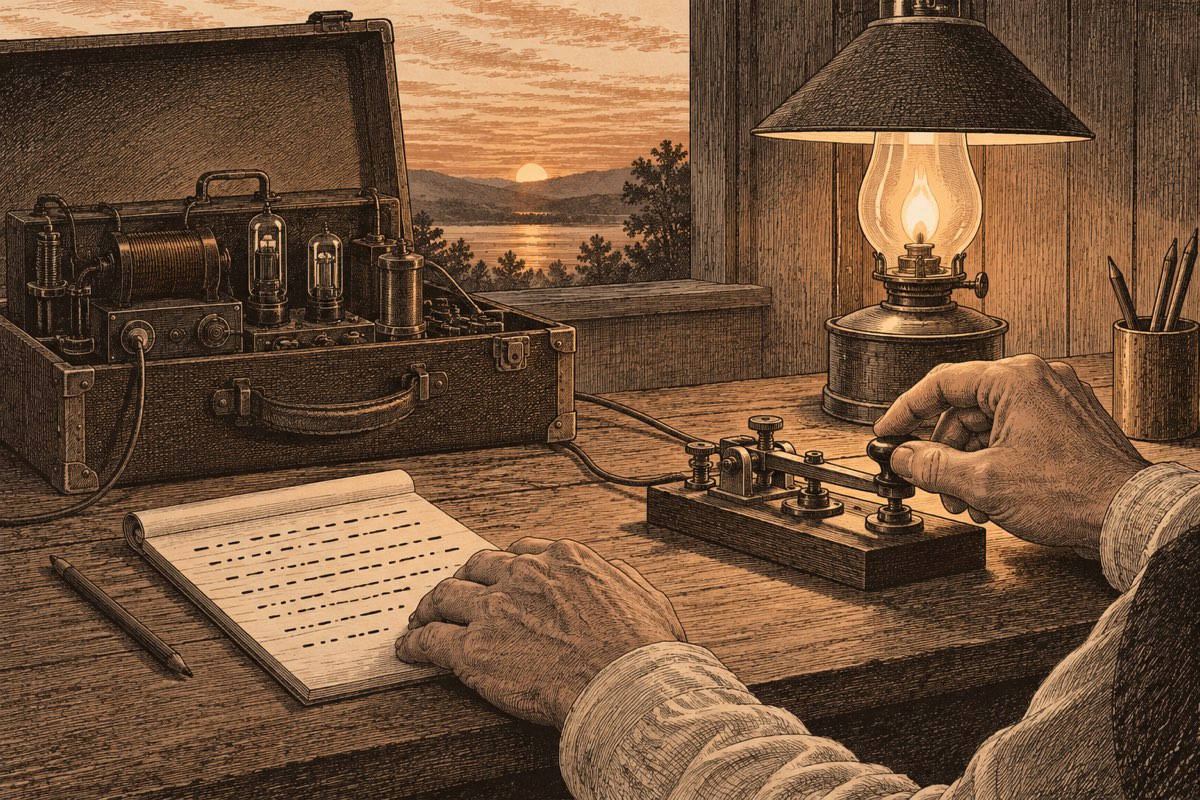
Morse code is defined by timing: a dash is three dots long, and the gaps between elements, letters and words have fixed lengths. In practice no hand-keyed operator sends with perfect timing. Some lengthen their dashes, some run certain letters together, some pause in characteristic places or have a habitual way of sending their call sign and sign-off. Telegraphers called this an operator’s fist, and experienced listeners could often recognise a familiar fist as readily as a familiar voice.
In the Second World War this had practical uses. Intercept operators who followed the same enemy networks day after day learned to recognise individual operators, which helped analysts follow a unit when it changed call signs or frequencies. The Allies also made it a measured technique, known as TINA. Signals were recorded, first as ink traces on paper tape and later on film, and analysts compared features such as the ratio between an operator’s dots and dashes, which proved to be one of the most consistent marks of an individual hand. British, Canadian and New Zealand naval women’s services and the US Navy used it to follow U-boat operators. In Britain, at least one intercept station was equipped for what was called radio fingerprinting, which identified transmitters by their technical characteristics.
Security checks
For clandestine agents a fist cut both ways. It could confirm an agent’s identity to the home station, but it could be noticed if it changed. The Special Operations Executive recorded each wireless agent’s sending of the full alphabet and the digits before they left, so that later traffic could be compared with it.
Because a captured transmitter could be worked by the enemy, SOE also gave each wireless agent security checks: a bluff check, which an agent could reveal under interrogation, and a true check, which was to be kept secret. Both were deliberate features, such as a particular spelling mistake or a letter in a fixed position, included in every genuine message. An agent sending under enemy control could leave the true check out to warn London.
In the Netherlands in 1942 and 1943 the home station did not act on the missing checks.
The Englandspiel
In March 1942 the German military intelligence service, the Abwehr, captured Hubertus Lauwers, an SOE wireless operator in The Hague. The operation was run by Major Hermann Giskes, and the Germans called it the Englandspiel, the England game. Lauwers agreed to send messages under German control. He left out both his bluff check and his true check, expecting London to realise that he had been captured.
SOE’s Dutch Section, under Major Charles Blizard, did not treat the missing checks as a warning. London went on sending instructions, supplies and new agents to drop zones that the Germans controlled. Arriving agents were arrested as they landed, and their own sets and codes were then worked back to England by German operators or by the captured agents themselves.
The deception lasted until late 1943. By then more than fifty SOE agents had been dropped into German hands, along with large quantities of weapons and equipment. Most of the captured agents were later killed, many of them at Mauthausen concentration camp in September 1944. Two agents who escaped and reached Switzerland were able to warn London.
What changed
The scale of the failure led to investigations after the war and lasting controversy in the Netherlands about whether SOE had been careless or had knowingly accepted the risk. The Germans ran similar radio deceptions, which they called Funkspiel, or radio game, elsewhere, including in France, using captured sets. Morse itself carries no signature, so only an operator’s sending habits and the agreed security checks could show who was really at the key.