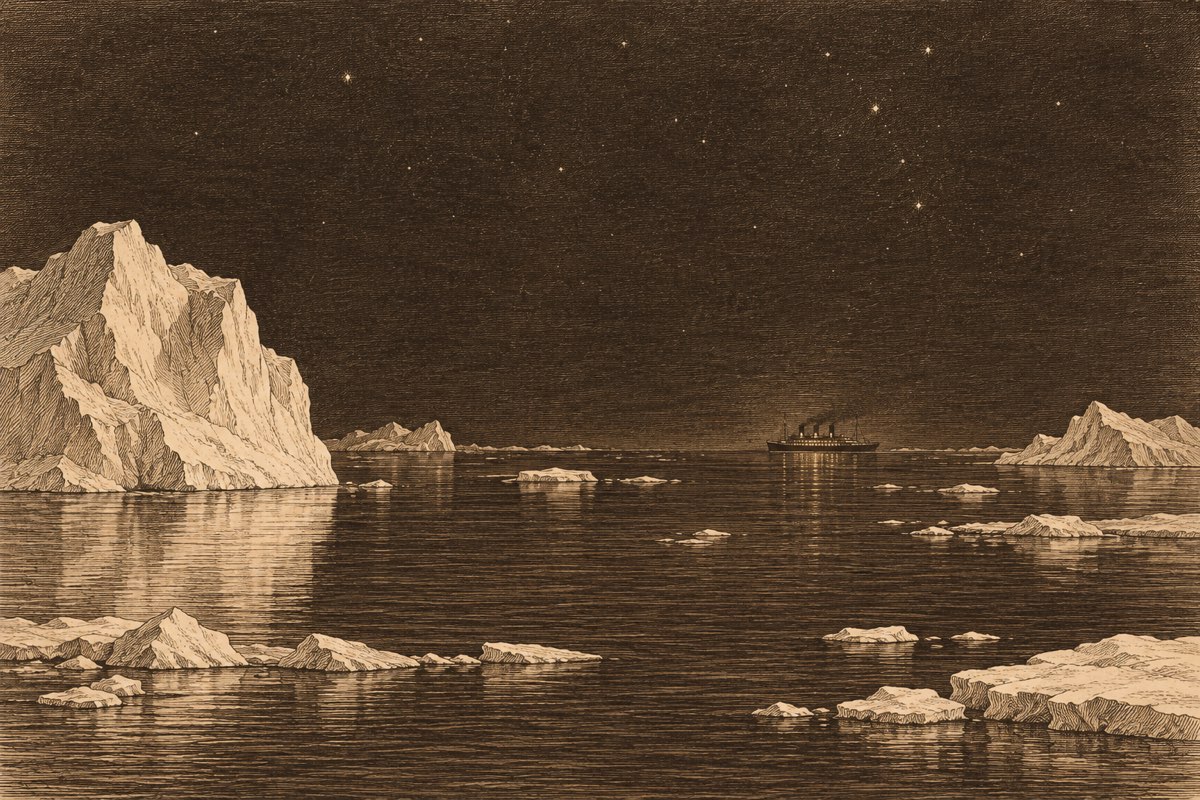
Five messages about ice
On Sunday 14 April 1912 the Titanic received a series of wireless messages about ice on the route ahead. The British Wreck Commissioner’s inquiry listed them in its report. At 9 a.m. the Cunard liner Caronia passed on reports from westbound steamers of “bergs, growlers and field ice” in latitude 42° N, between 49° and 51° W. Captain Smith acknowledged it.
At 1:42 p.m. the White Star liner Baltic relayed a report from a Greek steamer of icebergs and large quantities of field ice in 41° 51′ N, 49° 52′ W. Smith handed this message to J. Bruce Ismay, the chairman of the line, who kept it until about 7:15 p.m., when Smith asked for it back so it could be posted in the chart room.
At 1:45 p.m. the German liner Amerika sent a report of two large icebergs, addressed to the Hydrographic Office in Washington and passed through the Titanic for relay. The inquiry found that it “was never heard of by anyone on board the Titanic outside the Marconi room.”
Evening traffic
In the evening the Leyland liner Californian, bound for Boston, sent a warning of three large bergs five miles to the south of her position. Her only wireless operator, twenty-year-old Cyril Evans, first sent it to the Antillian, and the Titanic took it down as well. Harold Bride, the Titanic’s junior operator, said he delivered it to the bridge but could not remember to which officer.
At 9:40 p.m. the Atlantic Transport liner Mesaba reported “much heavy pack ice and great number large icebergs” in an area that lay across the Titanic’s course. The inquiry found that this message did not appear to have been delivered to the master or any officer. Jack Phillips, the senior operator, had been very busy since about 8 p.m. sending passengers’ private messages through the station at Cape Race, Newfoundland, which the Titanic had only just come within range of. Wireless operators were employees of the Marconi company, and passengers’ paid traffic was a large part of their work.
Later that evening Evans called the Titanic again to say the Californian had stopped, surrounded by ice. According to his testimony to the United States Senate, the Titanic’s operator replied: “Shut up, shut up, I am busy; I am working Cape Race.” Evans listened to the Titanic’s traffic for a while longer. By his own account, at 11:35 p.m. he took off his headphones and went to bed. He was the only operator on board, and there was no rule requiring anyone to keep watch while he slept.
Rockets and an empty wireless room
The Titanic struck the iceberg at 11:40 p.m. ship’s time, a few minutes after Evans turned in. Her distress calls went out within the hour. Officers on watch aboard the Californian saw rockets during the night and reported them to Captain Stanley Lord, but no one woke the wireless operator to find out what they meant. Evans learned of the disaster only when the chief officer woke him at about 3:30 a.m. by New York time and he switched on his set, by which time the ship that answered him reported that the Titanic had sunk.
The British inquiry concluded that the rockets the Californian saw were the Titanic’s distress signals, that the two ships were probably eight to ten miles apart, and that had the Californian pushed through the ice toward them “she might have saved many if not all of the lives that were lost.” A reappraisal by the British Marine Accident Investigation Branch in 1992, prompted by the discovery of the wreck in 1985, was divided over whether the Californian could have seen the Titanic, but agreed that the rockets had not been acted on.
The rules that followed
The British inquiry recommended that ships carry wireless “worked with a sufficient number of trained operators to secure a continuous service by night and day.” The United States had already acted: an amendment of July 1912 to the Wireless Ship Act required large passenger ships to carry two operators and keep a constant watch. The International Radiotelegraph Convention signed in London that July required a permanent service on certain classes of ship and set listening periods for the rest. All three followed from the Californian, whose operator had been asleep with the set off.