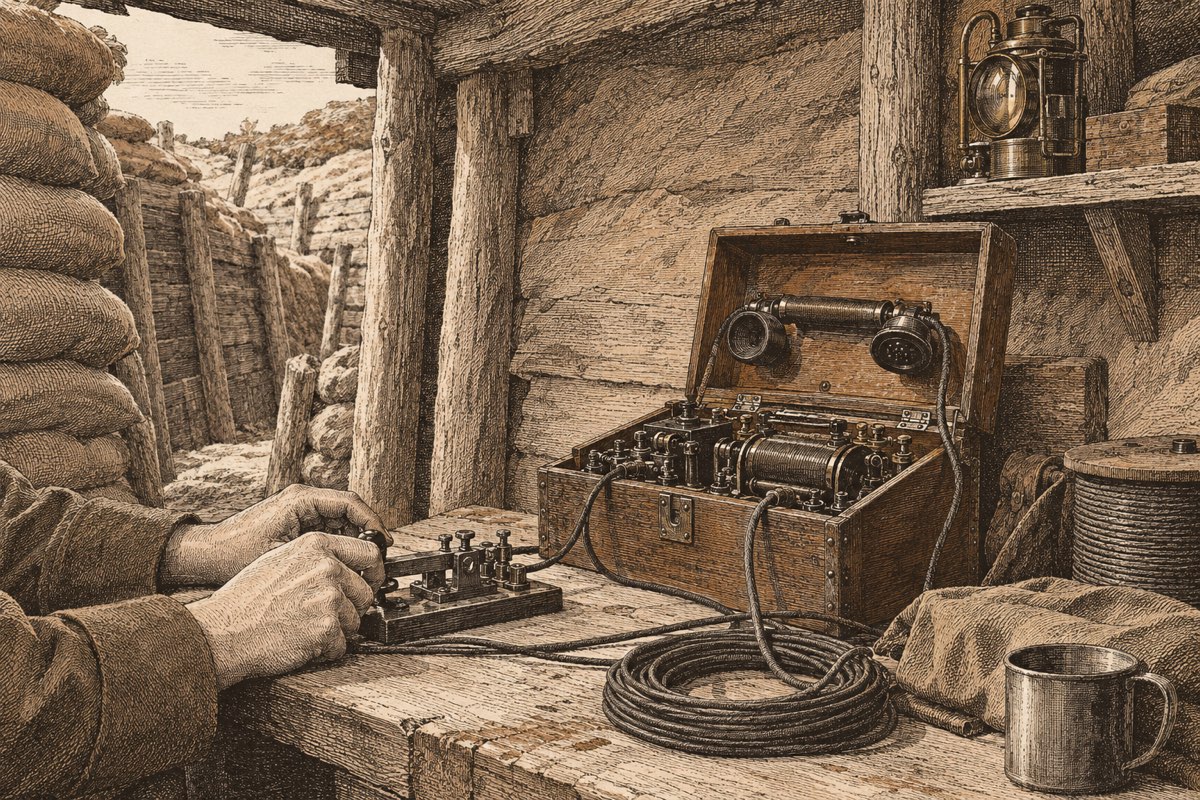
Wire to the front line
On the Western Front the British army’s Signal Service ran telephone and telegraph lines from headquarters forward to brigades, battalions and the front trenches. Much of this was field cable laid on the ground or in shallow trenches, cut regularly by shellfire and repaired by linesmen under fire. To save cable, many circuits used a single wire with the earth as the return path.
At the front, the instrument was often a buzzer. A buzzer telegraph sent Morse as a buzzing note through the line, which was easier to hear through heavy interference than the clicks of a sounder. The same field sets could be used as telephones or as buzzers, and a buzzer signal could still get through on a damaged line where speech could not.
An enemy listening through the ground
Earth-return circuits leaked current into the ground. In 1915 both sides discovered that a sensitive receiver connected to earth pins near the front could pick up the other side’s telephone conversations and buzzer signals. The Germans adapted earth-detection equipment from the mining industry into listening sets known as Moritz, which in time could pick up earth-return buzzer traffic at ranges of more than 3,000 yards. The British set up listening posts of their own, known as IT or I Toc stations. Careless conversation on a front-line telephone could give away an attack.
The British response included rules against sending unit names, officers’ names, locations and timings over front-line telephones and buzzers, enforced by courts martial, and a new instrument.
The Fullerphone
In 1915 Captain A. C. Fuller of the Royal Engineers Signal Service devised a telegraph that could not be overheard by induction or earth leakage. The Fullerphone sent a small, steady direct current down the line when the key was pressed. At the receiving end, a chopper interrupted that current to make it audible in the operator’s headphones. Because the current on the line was steady, there was no buzzing signal to leak into the ground and be heard by a listening set. The only way to read it was to connect a similar instrument directly to the wire.
Prototypes were tested in October 1915 with V Corps in Flanders, on a five-mile loop of cable that ran partly through the water-filled moat at Ypres. The Fullerphone gave a cleaner signal than the buzzer, worked over long, poorly insulated lines with very little current, and could share a telephone line without interfering with speech. It came into use on the Western Front from late 1915 and was widely used by 1918. Improved versions stayed in British service through the Second World War.
Light and flag
Where there was no wire, signallers sent Morse by light. The Lucas daylight signalling lamp, patented in 1916 by Oliver Lucas of Joseph Lucas Ltd in Birmingham, was a portable electric lamp that sent dots and dashes by switching a beam on and off, with coloured screens for use at night. The Imperial War Museums hold a photograph from May 1918 of a British corporal training American signallers of the 305th Infantry on it. Lamps could be aimed narrowly so that they were visible to the receiving station but not to the enemy in front. In good daylight, a heliograph could send Morse by flashing reflected sunlight. Flags were used for Morse and semaphore, though a signaller standing up to wave a flag in sight of the enemy was in serious danger.
None of these methods was reliable in battle. Runners, carrier pigeons and messenger dogs carried a large share of front-line messages, especially during attacks when lines were cut and smoke hid the lamps. The Royal Signals Museum records about 22,000 pigeons in British service in the war, kept in some 150 mobile lofts. Messages that did go by buzzer, lamp or heliograph, or by flag when it was not semaphore, were sent in Morse.