From railway men to a war service
In April 1861, with Washington cut off from the North by damaged rail lines and wires around Baltimore, the War Department called on the railways for help. Thomas A. Scott of the Pennsylvania Railroad came to Washington, and he brought Andrew Carnegie, then a young railway manager who had started his working life as a telegraph messenger and operator. Carnegie organised the reopening of the rail route and the telegraph lines that ran beside it, drawing on operators from the Pennsylvania Railroad.
Later in 1861 the government put the work on a permanent footing. Anson Stager, general superintendent of the Western Union Telegraph Company, was appointed to head the military telegraph, and the organisation became known as the United States Military Telegraph. It answered to the Secretary of War rather than to the generals in the field.
Civilians under fire
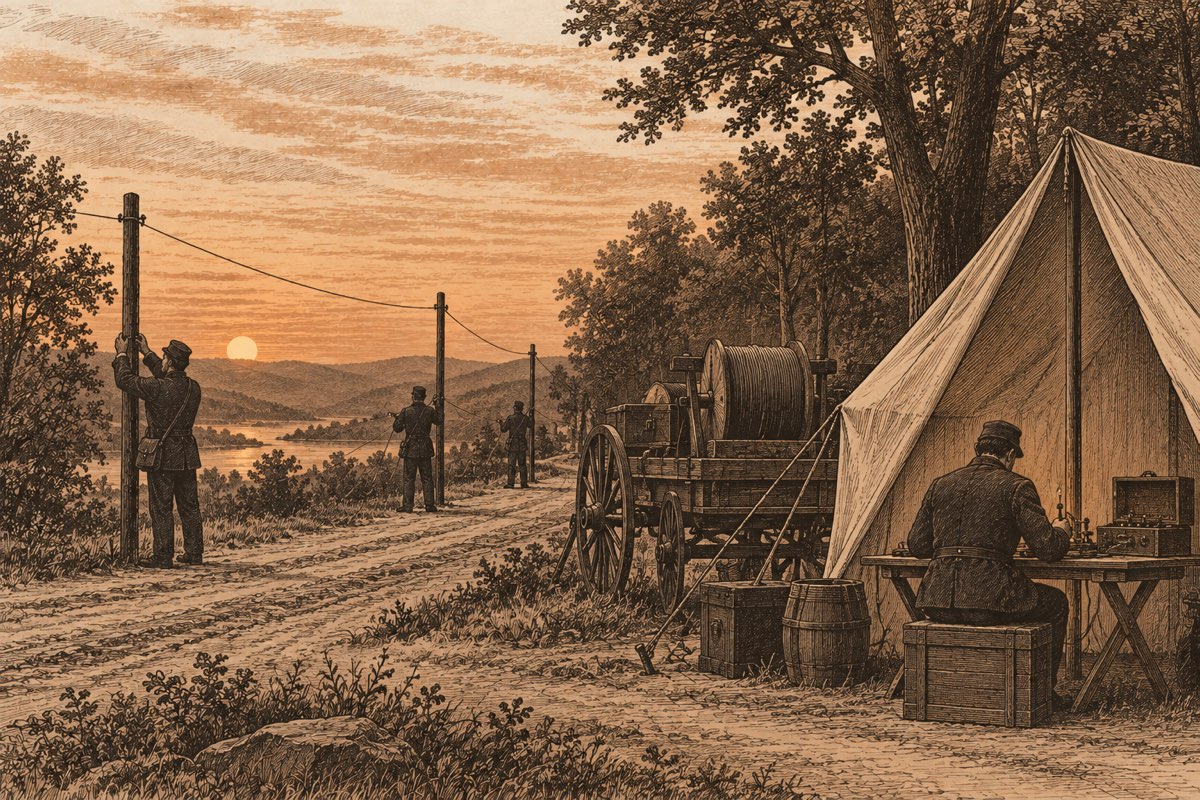
Most of the operators were civilians, hired through the Quartermaster’s Department. A few senior managers, Stager and Thomas Eckert among them, received commissions, but the men who strung wire and worked the keys did not hold military rank. They followed the armies, ran lines to headquarters during campaigns, and worked in tents and wagons near the front. They were not entitled to the pensions and recognition given to soldiers, and their status was argued over for decades after the war.
By the end of the war the service had built more than 15,000 miles of line. The operators sent and received several million messages, from orders and supply requests to casualty reports.
Ciphers on the wire
Anyone who could climb a pole and attach a wire could listen to a telegraph line, so military messages were enciphered. Stager devised the system the Union used for most of the war, a route cipher. The words of a message were written into a grid, extra words were added as padding, and the words were then copied out following a route through the grid set by a keyword. Important names and terms were replaced with code words. The result was still made of ordinary English words, which suited operators used to sending words, but the order made no sense to an eavesdropper.
Cipher operators guarded their keys closely and reported to the War Department. Generals did not always like this. Ulysses S. Grant clashed with Washington in 1864 over a cipher operator, Samuel Beckwith, who declined to hand over the key to a member of Grant’s staff on the grounds that his orders came from Stanton.
Rivals and wiretappers
The Army’s Signal Corps, led by Albert J. Myer, also ran field telegraphs. Myer favoured the Beardslee magneto-electric telegraph, which used a dial and pointer and could be worked by soldiers with no knowledge of Morse. It was slower and less reliable over distance than the Morse instruments of the civilian operators. The two organisations competed for the same work until Myer was removed from command in late 1863 and the field lines passed to the Military Telegraph.
The Confederates had fewer lines and operators but made good use of tapping. During John Hunt Morgan’s raids into Kentucky in 1862, his telegrapher George Ellsworth connected his own key to Union lines, read their traffic, and sent false messages in the style of Union operators to mislead troops sent after the raiders.