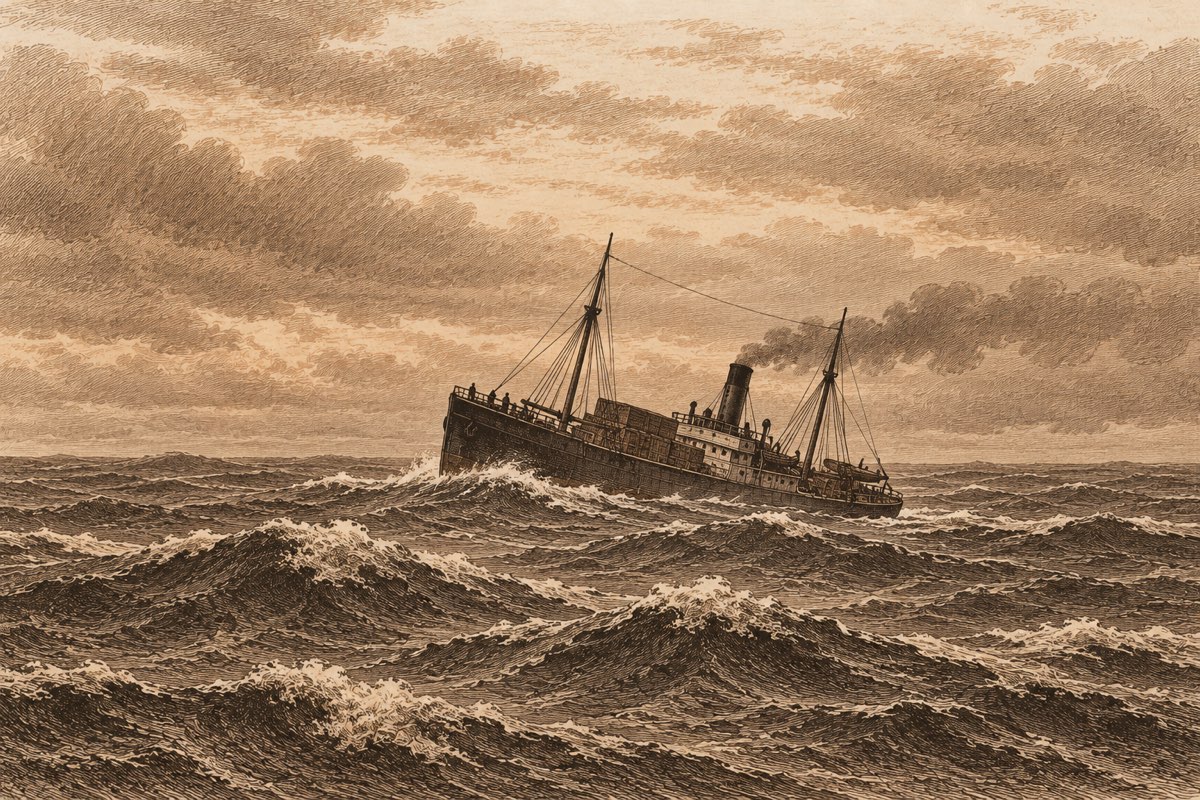
A ship taking water
The Lamport & Holt liner Vestris left Hoboken, New Jersey, on the afternoon of 10 November 1928, bound for Barbados and the River Plate with 128 passengers and 198 crew. On 11 November she ran into a severe storm. She began to take on water and to list to starboard, and the list grew through the day and the following night.
Through all of this the ship sent no distress call. The master, Captain William J. Carey, and his officers tried to correct the list and keep her going.
The calls
The first SOS went out at 9:56 a.m. on 12 November, more than a day after the trouble started. It gave a position that later proved to be wrong by about thirty-seven miles. A second SOS followed at 11:04. The chief wireless operator, Michael J. O’Loughlin, kept the set working as the list increased, and changed over to the emergency transmitter when the main power failed.
In the early afternoon the Vestris rolled over and sank, about two hundred miles off the Virginia Capes. The order to abandon ship had come late, and several boats were lost in launching. O’Loughlin was still at his post and went down with the ship, as did Captain Carey.
The rescue
The ships that answered the SOS steamed toward the position given and then had to search for survivors in the water and in boats. The first, the American Shipper, arrived at about 5:45 p.m. The French tanker Myriam, the North German Lloyd liner Berlin and the battleship USS Wyoming also took survivors. Of the 326 people aboard, 111 died: 68 passengers and 43 crew. All thirteen children aboard were lost, and 29 of the 39 women. The survivors were landed at New York and Norfolk, Virginia.
O’Loughlin’s name was later added to the memorial in Battery Park, New York, to wireless operators who died at their posts.
The inquiries
There were several investigations. In New York, the United States Commissioner Francis A. O’Neill held hearings in November and December 1928; the federal Steamboat Inspection Service under Dickerson N. Hoover made its own inquiry; and the Senate printed evidence on the disaster. The British Board of Trade held a separate inquiry.
Hoover’s report concluded that water had most probably entered through a broken scupper or sanitary pipe, rather than through a badly closed coal port as had been widely claimed. The investigations criticised the delay in sending the distress call and in getting the boats away, and found shortcomings in the boats and their handling. The loss came a few months before the international conference in London that produced the 1929 Safety of Life at Sea convention, and historians have suggested it influenced the conference’s work on lifeboats and distress procedure.
The Vestris carried wireless and trained operators, and her calls were heard once they were sent. The delay was in the master’s decision to send them.