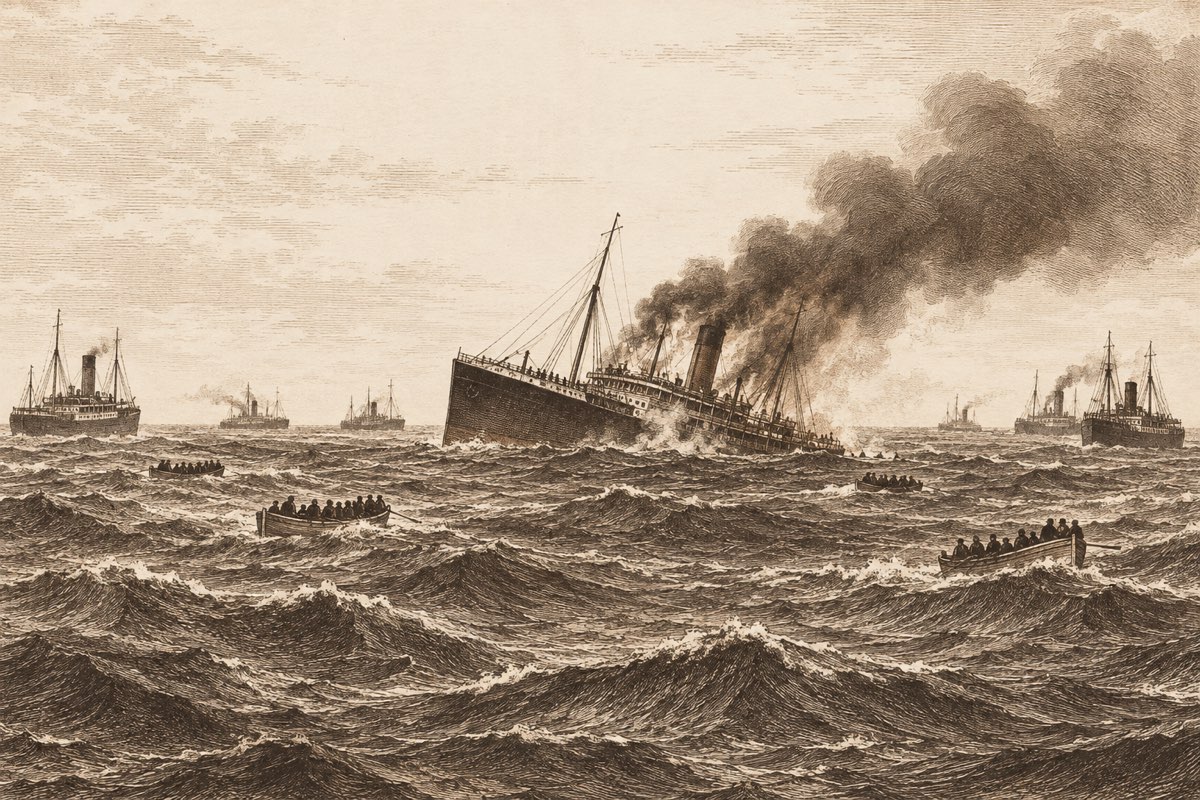
Fire in a gale
The Volturno was a British-registered steamer carrying emigrants from Rotterdam to New York. She sailed with 93 crew and 561 passengers, most of them in steerage. On the morning of 9 October 1913, in mid-Atlantic and in a full gale, smoke was reported coming from the forward hold. The fire spread quickly through the cargo, and an explosion followed. The crew could not put it out.
Captain Francis Inch decided he needed help. The ship carried two Marconi operators: Walter Seddon, the senior, and his assistant, C. J. Pennington.
SOS and the Carmania
Pennington was at the set and had already been in touch with another ship when Seddon reached the wireless room. Seddon took over and sent SOS with the ship’s position, then listened for answers between transmissions. The International Radiotelegraph Convention signed in London in 1912, which confirmed SOS as the distress signal, had come into force on 1 July 1913, three months before.
The Cunard liner Carmania, under Captain James Clayton Barr, answered almost immediately and turned toward the position. Other ships acknowledged the call over the following hours, among them the North German Lloyd liners Seydlitz and Grosser Kurfürst. The two operators entered every message sent and received in their log.
At about 7:45 a.m. the operators had to change to their emergency gear. They kept working until another explosion brought down the aerials, and nothing more could be sent.
Eleven ships
The Carmania arrived at about noon and found the Volturno burning forward, with the sea too heavy for ordinary boat work. Barr took charge of the rescue and used his own wireless to call other ships to the position. As the other ships arrived Barr organised them into a formation circling the burning ship, and by evening a ring of steamers stood around her. The heavy sea made boat work dangerous for the rescuers as well; the Carmania, the largest ship present, is credited with saving only one person.
Through the night and into the next morning they sent boats across. Ten of the eleven ships that came are credited with taking survivors: the Carmania, Czar, Devonian, Grosser Kurfürst, Kroonland, La Touraine, Minneapolis, Narragansett, Rappahannock and Seydlitz. The Volturno was abandoned on the morning of 10 October in about 48° 30′ N, 34° 57′ W. Seddon and Pennington both survived; Pennington left the ship only when the captain told the crew to jump, and was picked up by a boat from the Kroonland.
The count and the inquiry
The British Board of Trade inquiry, presided over by the Earl of Desart as Wreck Commissioner, gave its judgment in January 1914. It found that 30 of the officers and crew and 103 passengers had been lost, most of them in boats launched early in the day, before the rescuers arrived, which capsized or were smashed against the ship’s side. More than 500 people were saved.
The inquiry traced the fire to the ship’s cargo, which included barium peroxide, and noted that it was wireless that had brought the rescuing ships to the scene. The case went into the record alongside the Republic and the Titanic as an argument for wireless watch on every ship that carried passengers.