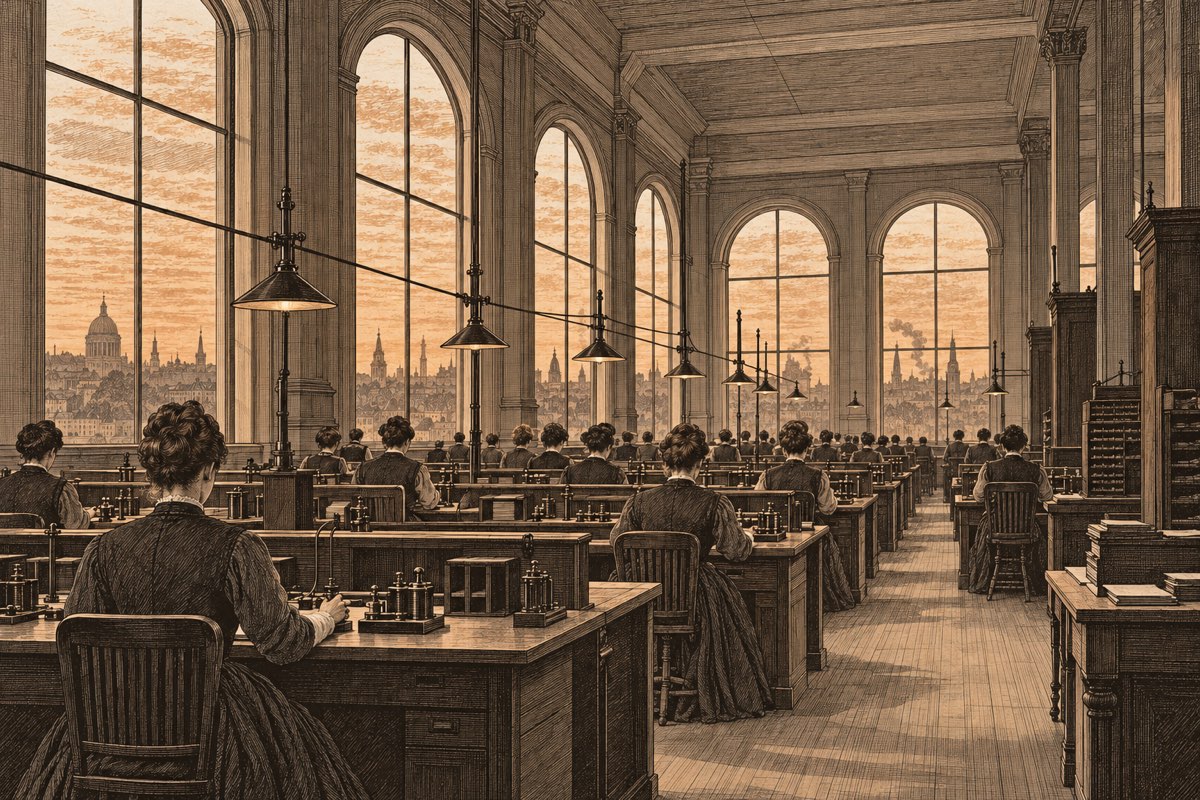
Sarah Bagley in Lowell
In 1846, two years after the first Washington–Baltimore line opened, Sarah G. Bagley became the operator in charge of the telegraph office in Lowell, Massachusetts, for the New York and Boston Magnetic Telegraph Company. She is generally regarded as the first woman telegraph operator in the United States. Bagley was already known in Lowell as a mill worker and labour organiser who had campaigned for a ten-hour working day. Over the next two years she ran the telegraph offices in Lowell and then Springfield before returning to mill work in 1848.
Other women followed in small numbers through the 1850s. Emma Hunter was hired in 1851 by the Atlantic and Ohio Telegraph Company at $50 a year. In 1855 the Pennsylvania Railroad hired Elizabeth Cogley as an operator at Lewistown; she worked as a telegrapher for 44 years.
War, schools and the big offices
Women’s employment grew during the Civil War as male operators left for military service. After the war the large city offices began hiring women in numbers. In 1869 Western Union opened a telegraph school for women at Cooper Union in New York, and its main New York office had a separate department of women operators. Women were generally paid less than men for the same work; the gap at Western Union has been put at between a quarter and a half of a man’s wage.
In Britain, women worked for the private telegraph companies from the 1850s, including the Electric Telegraph Company, and schools trained them for the work in London and Dublin. When the Post Office took over the inland telegraph companies in 1870, 1,535 of its 4,913 operators, about 31 per cent, were women. Maria Craig, who had joined the Electric Telegraph Company in 1853, became the supervisor of the women operators at the General Post Office, where she was responsible for 470 women by October 1870.
Working the wire
The work was the same for women and men. An operator sent by key, received by ear from a sounder or by reading tape, wrote out each message by hand and kept a record of what had passed through the office. Each office on a shared line had its own call letters, and operators heard all the traffic on the wire, including exchanges between operators in other towns when the line was quiet.
Those exchanges became the subject of popular fiction. Ella Cheever Thayer, who had worked as a telegraph operator at the Brunswick Hotel in Boston, published Wired Love: A Romance of Dots and Dashes at the end of the 1870s. It follows Nattie Rogers, a young operator in a city office, who falls in love with an operator she knows only through the wire. The book sold well for about a decade.
The strike of 1883
In July 1883 about 8,000 telegraphers, around a third of the operators in the United States, went on strike against Western Union and other companies. They were organised in the Brotherhood of Telegraphers, part of the Knights of Labor. Their demands included an eight-hour day, a general pay rise, and equal pay for women and men doing the same work. Women took an active part. Minnie Swan, an operator in New York, led the women strikers there, and Mary Macaulay, a Western Union operator, later became one of the first women to hold national office in an American union.
The strike collapsed after about a month without winning its demands. The number of women in the work kept growing. By 1920 about 16,860 of the 79,434 telegraphers in the United States, roughly one in five, were women.