Enigma went out as Morse
The Enigma machine enciphered German military messages, but it did not send them. An operator typed the plain text into the machine, wrote down the letters that lit up on the lampboard, and passed that ciphertext to a wireless operator, who sent it as ordinary Morse code in groups of letters. Anyone with a receiver could copy it. The difficulty was not hearing the message but reading it.
The codebreakers at Bletchley Park could only work on what was delivered to them. That depended on the Y Service, a network of wireless intercept stations in Britain and overseas, run by the army, navy, air force, Foreign Office and the Radio Security Service. The Bletchley Park Trust counts at least 178 Y stations and about 17,000 staff worldwide. The largest stations had more than a hundred receivers, and most of the operators were women in their late teens and early twenties.
The stations and the people
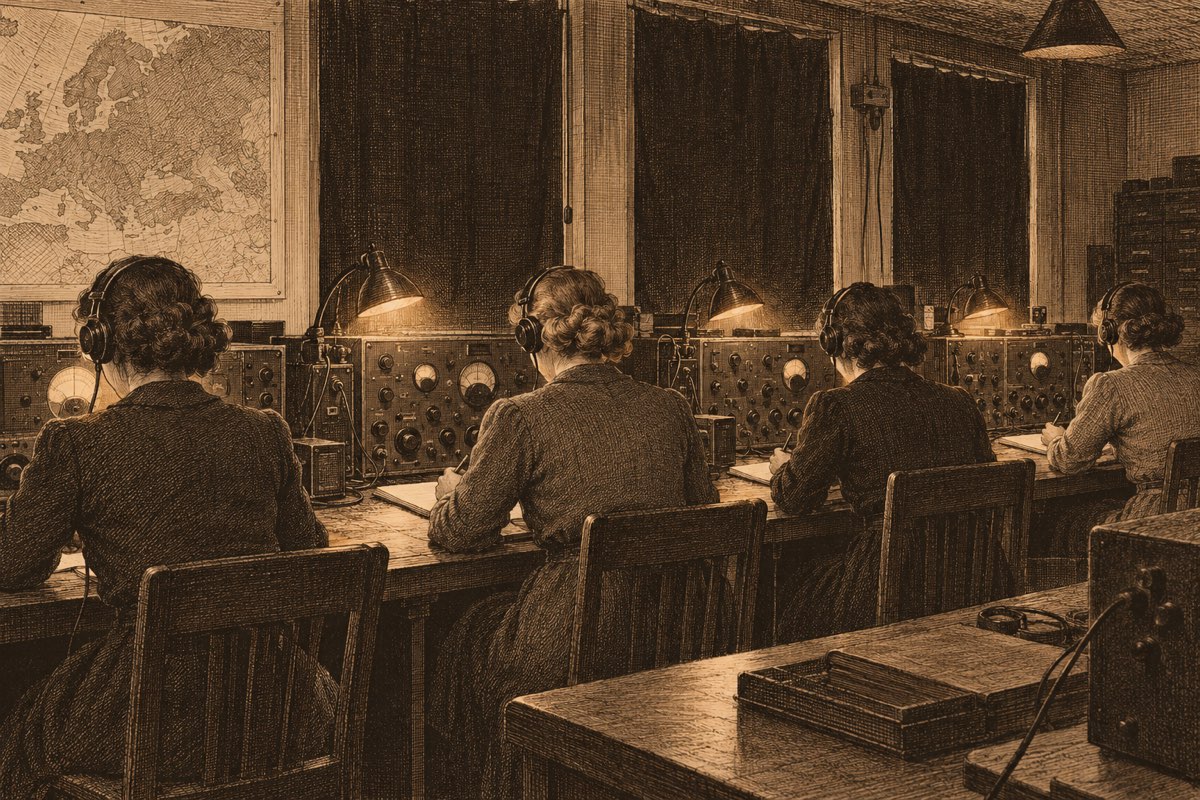
At the start of the war the intercept operators were men, many of them former military radio operators. As the war expanded, servicewomen took over a large share of the work. The Auxiliary Territorial Service began recruiting intercept operators in October 1941; the first ATS operators went on duty at Beaumanor in Leicestershire, the main army station, in May 1942, and by the end of the war more than 1,200 ATS operators were working there alongside about 300 male civilians. The Women’s Auxiliary Air Force worked at stations such as Chicksands in Bedfordshire, the RAF’s main strategic station, and Wrens worked at naval stations such as Scarborough.
The Radio Security Service also used about 1,500 Voluntary Interceptors, amateur radio operators who listened from home in their spare time. They were looking for the transmissions of German intelligence services, which used hand-sent Morse, three-letter call signs and groups enciphered on Enigma. Their logs went to the service’s headquarters at Hanslope Park, near Bletchley, and the enciphered material was passed on to be broken.
Training and speed
An intercept operator needed to copy Morse accurately at speed, often from weak and fading signals. The Bletchley Park Trust records a minimum standard of 18 words per minute for thirty minutes with no more than two errors, with 25 words per minute typical in operational work and some operators reaching 32. ATS recruits spent twelve weeks at a training battalion at Trowbridge in Wiltshire, then eight weeks of advanced training at Beaumanor and further time on live traffic. Many did not pass.
Copying cipher was harder than copying plain language. A trained operator receiving English can predict the next letter from context. Enigma ciphertext was random letters, so every character had to be heard and written correctly, and there was no way to guess a missed one.
From headphones to Bletchley
Operators sat at receivers for long shifts, searching assigned frequencies, logging call signs, frequencies and times, and writing each message by hand. Interference, fading and atmospheric noise were constant problems, and an operator might have to retune in the middle of a message to keep a signal. At Beaumanor, messages were written on standard forms known as W/T red forms, stamped with the time, frequency and operator’s number. A copy was sent to Bletchley Park by teleprinter, and the originals went by motorcycle despatch rider. At Bletchley, Hut 6 handled army and air force Enigma and Hut 8 handled naval Enigma.
The work was covered by the Official Secrets Act, and the operators did not discuss it. Like others who served in the British codebreaking effort, many did not speak publicly about what they had done until official secrecy about Bletchley Park’s wartime work was relaxed in the 1970s.